Travel Guides Spain | Guide to Salamanca
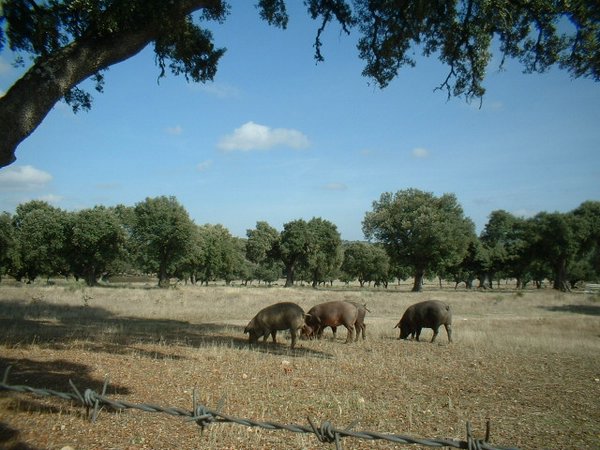 The
province of Salamana borders with Portugal and the provinces of Zamora, Ávila and Cáceres and
is one of the most magic provinces in Spain. Fertile lands watered by the riveres
Duero and Tormes, vast pastures used for cattle and pig farming, spectacular natural
parks, including the Arribes del Duero and Peña de Francia, picturesque
villages lost in time, and of course , its majestic capital, the City of Salamanca,
a World Heritage City, European Culture Capital in 2002, Spain's oldest university
and one of its most beautiful and monumental cities in the country (many would
say the most).
The
province of Salamana borders with Portugal and the provinces of Zamora, Ávila and Cáceres and
is one of the most magic provinces in Spain. Fertile lands watered by the riveres
Duero and Tormes, vast pastures used for cattle and pig farming, spectacular natural
parks, including the Arribes del Duero and Peña de Francia, picturesque
villages lost in time, and of course , its majestic capital, the City of Salamanca,
a World Heritage City, European Culture Capital in 2002, Spain's oldest university
and one of its most beautiful and monumental cities in the country (many would
say the most).
Salamanca capital city
Salamanca
is city reminiscent of Oxford or Cambridge in the sense that it seems to breathe
art, culture and knowledge as you walk along the streets and admire its señorial
houses, small palaces, university buildings, towers, churches, the cathedral....
. For the best panoramic view of the city, go to the Parador of Salamanca on the
other side of the River Tormes. Popular with thousands of foreign students who
come to Salamanca each year to study one of the Spanish language and culture courses
offered by the University or one of the seemingly hundreds of acadamies, Salamanca
is a cosmopolitan, lively city.
History of Salamanca
Like
most parts of Spain, Salamanca was occupied by the Romans and Visigoths. During
Moorish occupation of Spain power toed and froed between the Arabs and Christians.
In the 11th Century Alfonso VI consolidated Christian rule and appointed Count
Raimundo de Borgoña, to rule over the city. This was the beginning of Salamanca's
recovery, as the new stability encouraged people from all over the Iberian Peninsula
to make their home in the city. In the 12th century the Old Cathedral was built
and as it became a center of study, the seeds of one of Europe's first universities
were sown. As the center of study grew, so religious orders and scholars started
flocking to Salamanca, and their presence consolidated the University. Convents
were built, money was donated by the Catholic church leaders, residences for scholars
were built, and Salamanca became Spain's most important city during the Renaissance
period, resulting in the so-called Spanish Golden Age (Siglo de Oro) when Spanish
art, literature and music flourished. Fray Luis de León, Antonio de Nebrija,
Lope de Vega, Christopher Columbus, Calderón de la Barca, Teresa de Jesús,
San Juan de la Cruz, Cervantes and Christopher Columbus all spent part of their
lives in Salamanca. See photos
of Salamanca.
 Catedral
Viaja: XIII. The Old Cathedral of Salamanca. Unique façade
of this building which was to becometheone of Europe's main temples of knowledge
and scientific research, and the embrion of one of Europe's firstuniversities
Catedral
Viaja: XIII. The Old Cathedral of Salamanca. Unique façade
of this building which was to becometheone of Europe's main temples of knowledge
and scientific research, and the embrion of one of Europe's firstuniversities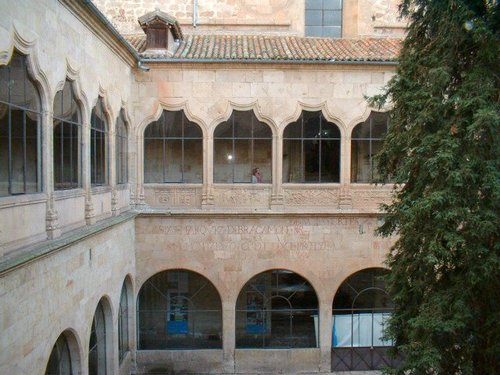 Casa
Lis Museum: Art nouveau and Art Deco, the Casa Lis Museum receives
more visitors than any othermuseum in the whole of Castilla y Leon. Open Tuesday-Friday
11.00-14.00 and 17.00-21.00. Sundays and public holidays 11.00-21.00.
Casa
Lis Museum: Art nouveau and Art Deco, the Casa Lis Museum receives
more visitors than any othermuseum in the whole of Castilla y Leon. Open Tuesday-Friday
11.00-14.00 and 17.00-21.00. Sundays and public holidays 11.00-21.00. Colegio del Arzobispo Fonseca: Rennaisance
patio. Cultural activities are organised here in the Summer months and next door
there is a former hospedería (hostal) where art exhibitions and other cultural
activities are held all year round.
Colegio del Arzobispo Fonseca: Rennaisance
patio. Cultural activities are organised here in the Summer months and next door
there is a former hospedería (hostal) where art exhibitions and other cultural
activities are held all year round.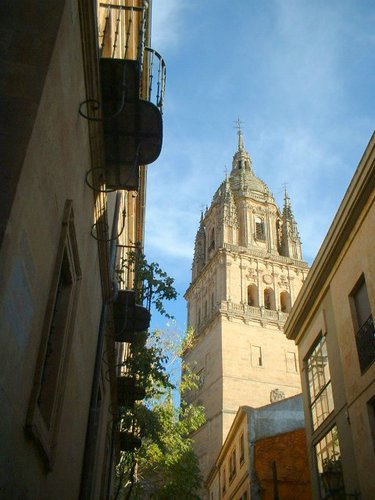 Convento de San Esteban: Spectacular
plateresque façade where in the center abovethe entrance is Ceroni's Martyrdom
of St. Stephen (1610). The church, designed by Juan de Álava in the shape
of a Latincross, was begun in 1524. The beautifu inner courtyard is a blends
Gothic andRenaissance styles.
Convento de San Esteban: Spectacular
plateresque façade where in the center abovethe entrance is Ceroni's Martyrdom
of St. Stephen (1610). The church, designed by Juan de Álava in the shape
of a Latincross, was begun in 1524. The beautifu inner courtyard is a blends
Gothic andRenaissance styles. 
Ciudad
Rodrigo: Ciudad Rodrigo sits on top of a hill just next to the border dividing
Spain from Portugal, and the wall surrounding this small town (14,000 inhabitants)
reflects its strategic importance in the past. Occupied by Neolithic settlers,
Vettones, Romans, Moors and finally Christians.
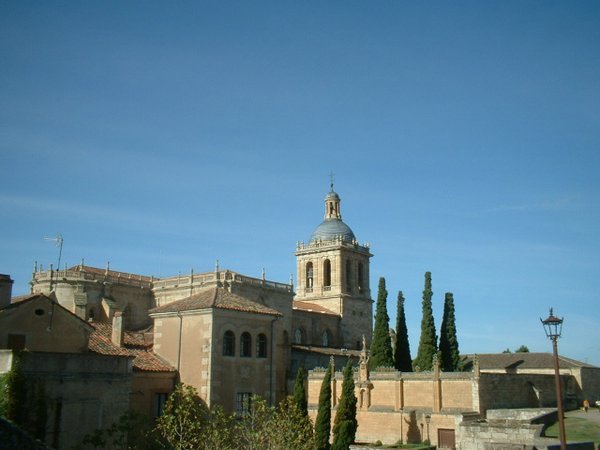 In
the 12th centuryCount Rodrigo González Girón give his name to the
city, and some years later the cathedral wasbuilt. During the 15th and 16th centuries
Ciudad Rodrigo flourished, and many of the small palaces and stately homes built
during that period are still standing today. Ciudad Rodrigo is a bit like a minature
Salamanca. Visitors are advised to stay in the beautiful Ciudad
Rodrigo Parador and to enjoy strolling around this sleepy town which oozes
history on every street. Se photos
of Ciudad Rodrigo.
In
the 12th centuryCount Rodrigo González Girón give his name to the
city, and some years later the cathedral wasbuilt. During the 15th and 16th centuries
Ciudad Rodrigo flourished, and many of the small palaces and stately homes built
during that period are still standing today. Ciudad Rodrigo is a bit like a minature
Salamanca. Visitors are advised to stay in the beautiful Ciudad
Rodrigo Parador and to enjoy strolling around this sleepy town which oozes
history on every street. Se photos
of Ciudad Rodrigo.
La
Alberca: Beautiful small village - just over one thousand inhabitants - with
narrow picturesque streets, unique half-timbered houses with geraniums hanging
over the balconies. And although it has become more crowded with tourists (mainly
daytrippers) in the last few years, Alberca still retains the unique charm to
which it owes its growing fame, despite the inevitable shops for tourists which
spill out onto the streets. Local fiestas in August are a mixture of pagan and
religious celebration, so typical of rural Spain.
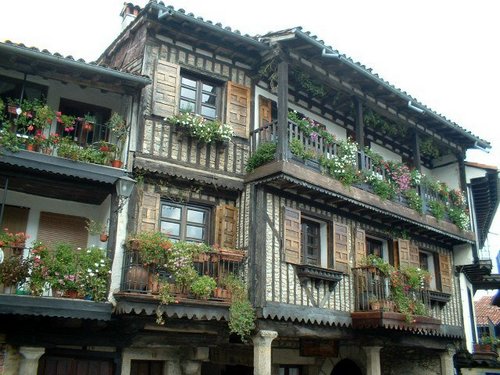
Set in the heart of the Sierra de France, a beautiful range of mountains, at the foot of the Peña de Francia and surrounded by fertile lands, Alberca is just 73 km. from Salamanca, and the drive there is lovely. If you go in Autumn, try one of the local dishes with setas, wild mushrooms. See Photos of La Alberca.
 Alba de Tormes; Village just 20 km. from Salamanca
set on the banks of the River Tormes in a lovely setting. Visit the 16th century
Carmelitas convent - Convento de la Anunciación - where the remains of
Santa Teresa are buried.
Alba de Tormes; Village just 20 km. from Salamanca
set on the banks of the River Tormes in a lovely setting. Visit the 16th century
Carmelitas convent - Convento de la Anunciación - where the remains of
Santa Teresa are buried.
Valle de las Batuecas: Beautiful unspoilt and unpopulated countryside, with all sorts of differentflora and fauna. Home to deer, mountain goats, golden eagles, black vultures and even lynx (an endangered species). Perfect for driving, stopping and walking. Se photos of Salamanca Province.
| Travelling to Salamanca? The following links may also be useful | |
|---|---|
| Guides provinces bordering with Salamanca and beautiful places in Spain nearby | |


 Travel guides to Spain