Saturday, April 28, 2007

Expansion of Santander Group

Record Profits for Santander Group

Santander Group obtained 1,802 million euros in the first quarter of this year which is 20.7% more than the same period in 2006 according to an official spokesperson.
Fortis, Royal Bank of Scotland (RBS) and Santander announced today that they have informed ABN Amro of their intention to launch a takeover bid for 100% of the social capital of the Dutch company.

Santander Group attributes the rate of growth in profits to the fact that money received by the group was more than double their costs.

The takeover bid depends on the terms of the contract that ABN has signed with the Bank of America with respect to LaSalle Bank. Barclays, who are also interested in taking over the Dutch entity, has placed the condition that ABN sells its subsidiary company LaSalle to the Bank of America. The new offer led by Santander Group however, places the condition that the Dutch bank does not get rid of LaSalle.

Dutch legislation forbids publicising the price of the offer for the timebeing although Santander, Fortis and RBS communicated their offer of 39 euros per share for the bank last Wednesday which would appear to be 13% more than Barclay’s latest offer of 75.500 million euros.

Santander, Fortis and RBS argue that their take over bid offers significantly more value for shareholders and advantages for clients and employees than Barclays'. They have requested a reply from ABN as soon as possible.

Related:
Santander Bank
Ranking of Spanish banks
Spanish banks

Labels:

Friday, March 30, 2007

This year tax payers in Spain can declare taxes via txt messages

Tax-payers in Spain will be able to make the annual tax declaration by text message or TDT interactive digital television

Tax declarations can be submitted as from the 2nd April for those people who accept their calculations sent by the Tax office. Confirmation of tax calculations can only be made when they are negative or result in zero.

For the first time tax declarations will be available using TDT interactive digital television using a decodifier and a telephone connection to be able to send information to the Tax Office using the TDT remote control. For example to apply for your tax calculation you would need to press in your national identity document number (DNI) together with the information from the box marked 681 from your last tax declaration – the same method as via the internet. Information will be sent in coded language directly between the person making the tax declaration and the Tax Office.

Tax declarations can also be made by sending a text message to 5025 with the message RENTA space the number of the form space Company Number (NIF). If making a joint declaration then you will need to leave a space between the first and the second NIF.

The reference number and the form number are those which appear in the tax calculation. Using this information together with your NIF is all you need to process your declaration.

As usual you can make your tax declaration via the internet with a reference number or by telephone by calling 901 121 224 (automatic - 24 hours) or 901 200 345 (with assistance), using electronic or telephone banking or by going to the Tax Office in person. As well as confirmation of tax calculations you can also obtain information on tax and property values.

Related:
Property taxes in Spain
Lower taxes for non-residents in Spain

Labels: ,

Friday, March 23, 2007

Financial services for immigrants in Spain

BBVA Bank to open special branches just for immigrants

The BBVA bank has decided to take maximum advantage of its branches by splitting the activities that are carried out in them. It has plans to open 30 ‘duo’ branches. Each of these offices will operate like a normal bank in the mornings and in the afternoon they will be prepared for use by immigrants, similar to the Dinero Express offices.

At 3 pm a screen will be used to divide the area normally used by the public in the mornings and a separate area with facilities like individual telephone booths, DHL cardboard boxes prepared for sending parcels abroad, and lists of properties on sale will be available. Applying for credit or a bank card and making a deposit will also be possible.

This part of the bank will be open until 10 pm and is intended to meet the special needs of immigrants. These branches will also open on Saturdays and Sundays.

According to Miguel Angel Muñoz, the BBVA Director of Banking for Immigrants, the branches will have staff made up solely of immigrants whose working conditions will be established according to the standard office workers agreement rather than the standard agreement for bank employees. The BBVA forecasts attracting 180,000 more immigrants to use the bank in 2007, a figure which would surpass a total of 700,000 immigrant clients.

Related:
Spanish banks
Ranking of Spanish banks

Labels:

Tuesday, March 06, 2007

Wealthiest areas of Spain

Navarra has the highest income per family

According to an article in El Pais, Madrid once again topped the 2006 table in the annual Fundación de las Cajas de Ahorros (Funcas) study which looks at economic growth within all the Spanish regions. According to their most recent survey Spanish GDP grew by 4.2% (3 tenths above that predicted by the National Institute for Statistics). The Comunidad de Madrid’s economy grew the most by 4.5%. However, Navarra came top of the table for disposable income per household (14,967 euros) compared to Madrid (14,852 euros) and the Basque Country (14,538 euros).

Madrid, the Pais Vasco and Navarra, are also the regoins with the highest GDP. Cataluña comes fourth in the table while Andalucía and Extremadura remain at the bottom of the list in terms of disposable income and GDP.

The study was carried out by Julio Alcaide, a leading economist. He indicated that the construction industry in Spain was the most dynamic making up 5.4% of the country’s economy. He also says that the economy in 7 regions saw above average growth in 2006. These regions were Murcia (4.4%), Andalucía (4.4%), Extremadura (4.3%), Castilla-La Mancha (4.3%), País Vasco (4,3%) and the Comunidad Valenciana (4.2%) as well as Madrid whose economy also experienced above average growth.

The Funcas study also looked at the evolution of regional economies throughout Spain over the last 7 years and according to the results Murcia saw the highest growth in GDP per inhabitant at 4.14%. With the average growth in GDP per inhabitant at 3.2% in Spain other regions which experienced above average growth were Andalucía (3.6% ), Madrid (3.5%), Cantabria (3.5%) and the Comunidad Valenciana (3.3%).

The Spanish economy performed well in comparison with the rest of Europe. Average Spanish income reached 94% of the average GDP per inhabitant in the Euro zone and 100% of the average for the European Union’s 27 members.

Funcas also pointed out that GDP per inhabitant in the region with the weakest economy, Extremadura, grew from 48% of Madrid’s average in 2000 to 53% in 2006.

Labels: ,

Tuesday, February 06, 2007

Spanish banks affected by hackers

People who receive and send emails are used to receiving fraudulent emails claiming to be from a financial institution asking for personal information regarding bank accounts.

In January hacking into banks and building societies in Spain resulted in fraud totalling 9 million euros according to the Spanish ‘Asociación de Internautas’. Banesto, Santander and La Caixa suffered the most attacks from hackers.

Víctor Domingo the president of the ‘Asociación de Internautas’ said that other institutions such as the National Statistics Institute were also under attack, something which hasn’t happened before.

It is believed that the hackers who carry out these attacks come from European countries such as Rumania or Bulgaria which makes it almost impossible to prosecute the perpetrators.

Related:
Spanish banks
Spanish savings banks

Labels: ,

Wednesday, January 24, 2007

Online shopping in Spain

68% of internet users in Spain shop online according to a study carried out by the Interactive European Advertising Association on European consumer habits and the internet.

France and Italy were also included in the study. The results showed that Spain occupies a middle position with France coming above Spain with 75% of internet users buying online. Italy came below Spain with 54% of users shopping online.
According to the results of the study the Spanish spend around 452 euros online, the French 509 euros and the Italians 454 euros. The study also showed that on average the Spanish buy around 5 different products online whereas the French buy 8 and the Italians 7.

The most popular products bought online were tickets for travelling (83% searches resulting in 55% purchases), followed by package holidays (77% searches resulting in 36% purchases) and music downloads (62% searches and 25% resulting in purchases).
The purchase of concert and festival tickets online was shown to have risen from 56% in 2005 to over 63% in 2006 and the legal downloading of music accounted for 37% of online purchases.

According to the study the purchase of mobile telephones has gone up by 23% followed by a 16% increase in music downloads. The purchase of car accessories increased by 15% and furniture sales by 14%.

The most noticeable increase was in concert and festival tickets with an increase of 75% bought online. The purchase of holidays rose by 72%, books by 71% and clothes by 70%.

The studied was based on telephone interviews in the United Kingdom Germany, France, Spain, Italy, the Nordic countries, Belgium and Holland.

Online shops in Spain
Shopping in Spain

Labels: ,

Wednesday, January 17, 2007

Earnings of immigrant workers in Spain

Funds transferred abroad by immigrants reached record high in 2006

Funds transferred abroad by immigrants in Spain broke the 5,000 million euro barrier last year. Between January and October 2006 the amount grew by 34.7% with respect to the same period the previous year according to the Bank of Spain.

The total amount transferred was 5,002 million euros in 2006 and in the month of October alone 576 million euros was transferred abroad by immigrants, an increase of more than 40% compared to October 2005.

This information shows how the number of immigrants living and working in Spain has grown gradually over the last few years. Since 2002 statistics show that the amount of money transferred abroad by immigrants has increased from 2,844 million to almost 6,000 million euros recorded at the end of 2006. Given this situation, the government has announced measures to reduce bank charges for the transfer of funds abroad.

Related: Immigration in Spain

Labels: ,

Monday, January 15, 2007

Most expensive city in Spain

According to the report on ‘Regional Economic Balance 2000 – 2005’ carried out by ‘La Fundación de las Cajas de Ahorros’ (Funcas), Barcelona was the most expensive city in Spain in 2005 while Badajoz was found to be the least expensive. On average prices for goods and services were 24% more expensive in Barcelona than in Badajoz. Gerona, La Rioja, Vizcaya, Guipúzcoa and Lérida were listed among the 10 most expensive regions while Soria, Cuenca, Cáceres, Salamanca and Ciudad Real were found to be the least expensive. The regions that consumed the most in relation to their income were Andalucía, Asturias and Galicia while Valencia, País Vasco and Navarra were found to be the regions that spent the least.

Extremadura and Castilla and León had the most public expenditure compared to Madrid, Baleares and Cataluña which had the least. Extremadura, Castilla-La Mancha and Galicia were the highest investors in training while Navarra, País Vasco and Madrid were the lowest investors.

The study carried out by Funcas also found that the rising number of immigrants settling in Spain accounted for the 14.9% growth in the Spanish population from 18 million to 21 million between 2000 and 2005. Gerona, Almería and Álava registered the most growth in each case above 60% while Zamora, Orense and Asturias, registered the least growth (below 50%) in this respect.

According to the study the number of unemployed went down by 2% which together with the number of immigrants means that the rate of employment has risen by 17%. The highest rise in employment was 19.8% in Almería compared to 3.33% in Lugo. The highest rise was seen in the Mediterranean and the North East of Spain.

Murcia, Madrid and Sevilla saw the highest economic growth registering more than the national average while Soria, Zamora and Lugo saw the lowest growth according to the study. Murcia grew by 4.26% in 2005 (the national average being 3.38%), followed by Madrid (4.10%) and Sevilla (3.94%). Cádiz (3.83%), Lérida (3.80%), Almería (3.67%), Córdoba (3.64%) and Vizcaya (3.53%) were also among the 10 other provinces which experienced the highest economic growth in contrast with Soria which had the lowest growth at just 1.16%, followed by Zamora (1.94%), Lugo (2,29%), Baleares (2,31%), Teruel (2,35%), Orense (2,36%), Álava (2,39%) and Huesca (2.46%). According to these figures Soria and Zamora were the only provinces whose economies did not grow by more than 2%.

Labels:

Sunday, December 17, 2006

Air Madrid crisis

Over the past two days, ever since the Spanish low cost airline Air Madrid cancelled all its operations on Friday in response to government threats to withdraw the company's licence because of repeated delays and cancelled flights, the angry scenes witnessed at several Spanish airports have turned into expressions of grief and desesperation as passengers expecting to fly home this weekend and spend Christmas with their families, have had to face up to the idea that they might have to spend their holidays alone in Spain, despite having bought their flights months ago.

Until Friday, Air Madrid operated flights to 12 destinations in Latin America, and the low prices and online booking offered by the airline drew thousands of customers from communities of Latin American immigrants living and working in Spain to send money home to their families. For many of these people, this year was going to be the first Christmas spent at home with their families for years.

Representatives from the Transport Ministry said yesterday that the government's priority was firstly to attend to passenger's needs, even though in theory Air Madrid should have found alternative transport for all of its customers, and second to consider taking legal action against the company. The airline has limited its response to publishing a communication on its website claiming that the "very serious" government threats and actions have forced it to cancel all flights and other services.

Yesterday Transport Ministry staff said they were doing all they could to help stranded passengers. The government's main problem was first to identify just how many people were are affected by the crisis, and a Ministry spokesperson said that the only information given to the Ministry by Air Madrid to facilitate the location of affected customers was a list contained in a "lamentable" database .

So far in the past 48 hours the Ministry has managed to put over 7,000 passengers on alternative flights on routes already operated by other airlines, or on flights commissioned by the government itself.

Related:
Cheap flights to Spain
Air travel to Spain

Labels:

Friday, December 08, 2006

Average spending at Christmas for a Spanish family

According to the Spanish Confederation of Consumers and Users, the average Spanish family will spend 1.068 euros on Christmas this year.

Spaniards will spend the largest share of this amount - 350 - on food, 183 on meals at home and the rest on eating out. Another 300 euros will be spent on toys and other presents and as usual, families will spend on average over 100 euros (this year 144) on the Christmas national lottery.

The Federations advises consumers who want to cut costs this Christmas to avoid last minute Christmas shopping, to plan and buy for Christmas meals early on, to plan carefully before buying toys and presents and to stick to a list and a maximum expenditure plan.

Related:
The cost of Christmas in Spain
Christmas spending in Spain
Spanish Christmas lottery

Labels:

Monday, October 23, 2006

Iberia lowers its fares

Iberia has announced that as from today all its international flights will be a little cheaper because of the downward trend in international oil prices.

The Spanish airline has announced a reduction of 2 euros on the fuel charge of all its medium-distance flights (to European destinations) and a reduction of 3 euros on long-haul flights to the US, Latin American countries and South Africa. According to the press release sent out by Iberia today, prices could be revised again soon depending on possible fluctuations in prices of fuel in the future.

Iberia is the latest of several European airlines to announce a reduction in fares, although some have been more generous than others. Last week Lufthansa reduced the fuel charge on long haul flights by ten euros, and Air Europa announced plans to cut fares on its European flights by between one and seven euros, and on its long haul flights by between six and fifteen euros.

Last month the Dutch airline KLM reduced fares by five euros on its intercontinental flights and one euro on European flights and Air France by one euro on domestic flights, two on European and seven on its long haul flights.

Iberia's online ticket sales on the rise

This month the Spanish airline announced that online ticket sales increased by 62 percent in the first nine months of this year with respect to the same period last year. 71 percent of all online purchases originated in Spain, representing a 55.5 percent increase compared to last year.

Related:
Cheap flights to Spain
Air travel to Spain

Labels:

Thursday, October 19, 2006

Deceleration in Spanish house prices

Figures released yesterday by the Housing Ministry in Spain confirmed that during the last three months the trend of a slower rise in the price of houses continued, suggesting that the sharp rise in prices experienced by the Spanish housing market over the past few years has indeed reached its peak.

According to Ministry figures, house prices rose by just 9.7 percent during the last term, the first time in five years that prices have risen by under 10 percent and 1.1 percent less with respect to the first three months of 2006.

In some areas of Spain, for example some areas of Madrid, prices have actually started to fall, although this is not true in the case of new developments in popular coastal resorts. Properties most affected by the latest trend are resales in large urban areas where new developments and off-plan purchases prove an attractive option for first-time property buyers.

Related:
Property market in Spain
Buying property in Spain
Houses for sale in Spain

Labels:

Friday, September 22, 2006

Changes in state funding of Church

The Spanish government and Catholic Church agree on new funding system

The Socialist government in Spain and the Catholic Church have signed an agreement centering around the traditional system of state funding of Church activities. Up until now, the Spanish Catholic Church has had two main sources of public finance: firstly an annual allowance given to the Church by the Government, and secondly voluntary donations paid by Spaniards in their yearly tax declarations and then passed on to the Church by the Tax Office.

However according to an announcement made today by Spain's Vice President, the State will no longer have to pay an annual allowance to the Church. To compensate, the voluntary donation of taxable earnings has gone up from 0.52 percent to 0.7. This means that tax payers can pay 0.7 percent of their income tax to the Church rather than to the Tax Office. Church representatives present in the negotiations with the Government had asked for 0.8 percent.

Another change in the previously privileged position of the Catholic Church is that from now on it will have to pay VAT on the purchase of all goods and properties. It will also have to present to the Government each year a financial report detailing how the money received from the Tax Office has been spent.

The Government claims the new agreement will make the system more transparent and, according to its Vice-president, hopes that it represents the first step towards its ultimate objective: a Spanish Catholic Church capable of financing its own activities without relying on state funds. The system comes into effect at the beginning of next year.

Related:
Spanish Catholic Church in condom crisis
Spain's Catholic Church campaigns against Government
Priest celibacy in Spain
Pope receives Zapatero in the Vatican
Spain legalises gay marriage

Labels: , ,

Saturday, September 02, 2006

Process open for Fórum Filatélico investors to claim compensation.

Proceedings are now open for Fórum Filatélico investors to claim compensation. Investors need to make their claims to the ‘Juzgado de lo Mercantil número 7 de Madrid’ before 2nd October. It is believed that the company had approximately 200,000 clients.

Fórum Filatélico is accused of defrauding its clients by operating a pyramid scheme in which clients invested money in the company in exchange for stamps with a guaranteed a minimum profit margin. However it is believed that the company used money from new clients to pay off the returns to previous clients. Figures for the massive fraud are believed to be around 2000 to 3,400 euros.

Clients of the company should have received letters with information and instructions on how to proceed with their claims for compensation.

Labels:

Friday, September 01, 2006

Compensation for passengers affected by strike at El Prat

The government has put forward a plan in which passengers who were affected by the strike at El Prat airport on the 28th July will receive compensation.

El Prat, one of Spain's major airports, was closed unexpectedly on one of the busiest days of the holiday season. Runways were invaded by a group Iberia’s baggage handlers protesting against the possibility of subcontracting their work to other companies, something which they said could result in up to 900 Iberia staff being made redundant.

The consequences were that almost 800 flights had to be cancelled and many more were seriously delayed. It is expected that measures will be approved today and that 15 – 20 million euros will be paid out in compensation to passengers. The final costs are unknown. A bill for the total costs of compensation will later be given to Iberia.

It is thought that 300 euros will be paid to passenger’s whose flights were cancelled and 100 euros to those who were delayed. It will be up to passengers to give proof. These measures have been put into place following a government meeting on 10th August in which the Minister for Industry, Magdalena Álvarez, made a commitment to help those affected. It was also agreed that proceedings would be taken against Iberia for breach of air traffic security.

So far over 20,000 claims for compensation have already been made although this figure is expected to rise significantly.

Labels:

Monday, August 28, 2006

Congestion charges in Spanish cities

The government is considering introducing congestion charges for cars circulating in Spanish cities. The idea will be debated in PSOE's annual political conference due to take place between 15th - 17th September. The congestion charges would work in a similar way to those already in place in other European cities like London and Rome. In large German cities like Frankfurt and Cologne motorists will be charged as from 1st January.

Although PSOE admit that introducing charges is a controversial proposal it would only be under certain conditions. Each city would have the right to decide whether to introduce the charge and be able to adapt it accordingly to suit their interests.

However, it is unlikley that the idea will be approved at the conference given that PSOE has worked towards reducing car tolls on motorways for example in Galicia and Andalucía due to their unpopularity.

Some of the reasons behind the idea of introducing congestion charges are protecting historic buildings, improving public transport and improving the environment in city centres for its inhabitants. A similar idea was put forward by the Ministry for the Environment in 2004.

Other ways of improving the city centre and reducing traffic would be to introduce more bus lanes, introduce lanes for cars carrying more than one passenger, prohibit loading and unloading during the rush hour, create more cycle lanes and pedestrianised streets and introduce more environmetnally friendly public transport.

Related:
Driving in Spain
Roads in Spain
New penalty points driving license system in Spain
Driving from Spain to England
Driving offences in Spain
Drink driving in Spain

Labels:

Friday, August 25, 2006

Easyjet to set up new base in Barajas

Easyjet, the British low cost airline company, has announced that it is to invest 100 million euros in setting up a new European base in Barajas, Madrid which will start operating in February 2007 making it the airlines 17th operative base in Europe. More details will be made public later next month.

Andy Harrison, Easyjet’s spokesperson justified Spain as first choice saying that Spain offered 'excellent opportunities for growth given that air travel was still dominated by traditional carriers'.

Easyjet has been operating since 1998 and is the fourth largest operator after Iberia, Spanair and AirEuropa. In 2005 it carried 900,000 passenger, double the figure for the previous year.

At present Easyjet operates from 12 Spanish airports: Barajas, Barcelona, Asturias, Bilbao, Valencia, Murcia, Almería, Málaga, Palma de Mallorca, Menorca and Ibiza.

Labels:

Saturday, August 19, 2006

Ex-President of Fórum Filatélico Released on Bail

Francisco Briones the Ex-President of Fórum Filatélico was released from prison yesterday after paying 1 million euros in bail. Under his bail conditions he must report to the police every three days, his passport has been confiscated and he is forbidden to leave the country.

According to sources representing Briones clients and former employees have voluntarily contributed 300,000 euros to his defence fund.

Briones is the last of the four Fórum Filatélico executives to be released under bail. He was detained in May following accusations that the investment company had been defrauding its clients by operating a pyramid scheme.

Labels:

Thursday, August 17, 2006

Telefonica broadband users advised to claim compensation

The Ministry for Commerce and Industry has today advised those affected by last Tuesday's broadband connection problems with Telefonica to claim compensation.

From the early hours of Tuesday morning thousands of Telefonica's broadband clients throughout Spain were left without connection. At first Telefonica blamed the problems on software failures but then later on attributed them to a massive electrical storm in Barcelona.

The National Consumers Association (FACUA) has requested that the government open an investigaton into the incident. It has also requested that all broadband clients who were affected receive automatic compensation. FACUA has also complained that Telefonica did not make the problems public until the media demanded clarification.

Ya.com and Wanadoo users were also affected given that these companies rely on Telefonica in order to provide their broadband services.

Labels: ,

Wednesday, August 09, 2006

Madrid most expensive place to buy a property

According to the latest economic study by one of Spain’s leading banks, the Caixa Catalunya, buying a new flat in Madrid would cost over 40% of household income. This comes at a time when 60% of families can’t even afford mortgages totalling 40% of their income.

Madrid is the most expensive place to buy a property in Spain followed by the Basque Country in second place and the Balearic Islands in third place.

In Catalonia it is estimated that families need to dedicate around 30% of their net household income to paying their mortgage, a similar figure in Asturias and Valencia.

Other places in Spain where buying a property requires less than 30% of total net income are Extremadura Galicia, Castilla-La Mancha, Castilla-León, Murcia, Navarra, La Rioja, Aragón, Cantabria and the Canary Islands.

A relatively strong economy, low interest rates and demand outstripping supply are just some of the explanations for the recent property price boom. However this has led to a situation where property prices have risen disproportionately in relation to average salary levels over the past few years. The reality of this situation means that a high percentage of households throughout the country have no chance of getting onto the property ladder.

Labels:

Tuesday, August 01, 2006

Interest rates in Spain

The Euribor rose to 3.54% in July which means that overall interest rates have risen 1.37% in the space of a year.

It is predicted that mortgage rates will continue to increase given that the Euribor, on which mortgage rates are fixed, has seen its 10th consecutive rise and has reached its highest level since July 2002. It was just 2.168% at its lowest in July 2005.

The rise means that the average 20 year mortgage in Spain of 140.000 euros, which is due for its annual revision will increase 100 euros per month which works out at an extra 1200 euros a year. This increase is calculated on the basis of the Euribor base rate plus the percentage added by the bank. This is a worrying trend for mortgage holders given that property prices are already at an all time high.

For first time buyers the situation is even more serious as prices continue to go up, albeit at a slower rate that the past couple of years, making affordability less and less likely for this group of buyers. Madrid, Barcelona, San Sebastian and Bilbao continue to be the most expensive cities in Spain although prices on the Mediterranean have also shot up in recent years.

Labels:

Monday, May 15, 2006

Protests over the price of housing in Spain

Thousands of young people took to the streets yesterday in 60 towns and cities to protest at the price of housing in Spain and to ask the Spanish government to do something to protect the right of young people to buy a decent house.

The protests were organised spontaneously via e-mail messages, websites and sms and were not coordinated by any youth organisation, trade union or any other protest group. The biggest protests were held in Madrid and Barcelona where more than one thousand protesters gathered at the Puerta del Sol and Plaza de Catalunya respectively, and in Valencia (900 protesters). In other towns like Sevilla, Granada, Cordoba, Bilbao and San Sebastian, the concentrations were smaller with 200 to 150 participants.

During the protests, the participants sat down and chanted slogans criticising national and local government for failing to guarantee the right to a house by allowing property prices to rise above what many people can afford. They also criticised real estate speculation with chants like "Hands up, this is a hold up" or "Protect our right to a roof. Housing isn't a business. It's a right".

Labels:

Sunday, April 30, 2006

Spanish Santander Bank announces new profits

According to a statement made by Spain's Comisión Nacional del Mercado de Valores (CNMV), the position of leading Spanish bank Santander grows in strength as the bank enjoyed increased profits during the first quarter of this year. Net income during the said period rose by 26 percent to 1,493 million euros.

This rise in profit is partly thanks to the performance of Abbey, acquired by Santander in 2004 as revenue from the British bank rose by a massive 76 percent to 244 million euros largely caused by the cost-cutting policies carried out last year.

The Santander Bank has also had a very successful term in its operations in Latin America, where profits grew by 47 percent to 618 million euros. The Santander Bank has acquisitions in Latin America worth over $16 billion dollars, and the bank's shareholders will be delighted with the performance of its banks there which comes just when the rise in interest rates in Spain caused by the rise in Euriber is likely to slow lending growth at Spanish banks.

Net interest income increased 23 percent to 2.89 billion euros from 2.36 billion euros and fee income rose 24 percent to 1.75 billion euros.

Labels:

Monday, February 13, 2006

Property for sale or rent in Spain

Euroresidentes has, over the past few years, slowly but surely become one of Spain's largest webs, with more than 12 million visits each month. Euroresidentes began as a website specifically designed to answer the questions and needs of Europeans and expats looking for information about different aspects of living in Spain: travelling, holidaying, shopping, learning about the culture or buying a house in Spain. Infact, one of our most popular sections, in Spanish, English, French and German, is Property in Spain.

Over the past year or so we have signed agreements with various institutions, law companies and banks aimed at creating special products and standards of service for non-resident property-buyers in Spain, including agreements with Caja Madrid and Bankinter. Since Euroresidentes was launched six years ago, we have answered thousands of queries from people looking to buy their dream home in Spain, and in need of specialised advice, a bit of encouragement, or a word of warning as each case may be. And as the number of people abroad looking for property in Spain continues to grow, and with it the demand for information, our policy is to remain objective in the advice we offer to our users.

Property for sale in SpainIn response to the growing demand for people looking to buy property in Spain, we have collaborated in the design of a new resource for visitors looking for property for sale or property for rent in Spain called Tutipi ( http://www.tutipi.com ). We have always been unwilling to recommend the services of one estate agency or promotor or another, despite requests to do so from potential buyers or property developers themselves. While we have passed on testimonies of satisfied customers to users asking us our opinion about one developer or another, we do not endorse the services of any particular company or agency.

But as the requests from users looking for property in Spain and asking advice increase each year, we have decided to go one step further and created a site which is completely free, both for people advertising property, and buyers looking for property in Spain. This way we hope to connect supply with demand within the democratic framework offered by Internet.

Tutipi enables property sellers to publish plans and photos and will eventually replace our other more basic Spain Property for Sale and Spain Property for Rent noticeboards altogether. The service is free for everybody. As always any comments from our users, sellers, buyers or just helpful visitors, are more than welcome. And as the list grows and users find (hopefully) a bargain opportunity just in the area they wanted, our usual advice mot to rush into a purchase but to get proper legal advice before parting with any deposits obviously applies.

Labels:

Wednesday, January 11, 2006

Wages in Spain

According to a report published yesterday by the Inland Revenue Office in Spain about the Spanish labor market and pensions, men earn salaries which are on average 30 percent higher than those of women. The average annual salary of men in 2004 was 17,964 euros, compared to 12,464 for women - a difference of 5,500 euros per year. If you multiply this amount by 40 (years in an average working life) the total difference adds up to almost a quarter of a million euros. Which is a very big gap indeed.

The study puts the difference down to the fact that the relatively recent incorporation of women into the labor market in Spain on a large scale means that they earn less because they have been employed for fewer years, and that their jobs tend to be more at risk than in the case of male employees. Furthermore, mothers tend to put their children's interests before their own professional development, and the percentage of women working part time in Spain is higher than in any other European Union member state. The report also highlights the lack of equal opportunities for women compared to men as far as professional promotion is concerned.

Statistics show that 58 percent of workers between 18 and 45 years old are men, and 42 percent women, whereas for workers between 45 and 65, the difference is much higher (over 20 percent).

Not surprisingly the report puts wages in Madrid at the top end of the scale, followed by Ceuta, Melilla and Catalonia (in that order). Jobs in the Energy and Water and Banking industries boast the highest average wages (31,846 and 28,911 euros respectively) whereas the Tourism (8,680 euros) and Trade (11,360 euros) industries offer the lowest average wages.

Related:
Unemployment in Spain at all-time low

Labels:

Tuesday, December 20, 2005

The cost of Christmas in Spain

According to the results of a study carried out by the Independent Federation of Users and Consumers, Christmas spending in Spain this year is expected to by just above average spending last year.

Spanish consumers are expected to spend an average of 833 euros on their Christmas this year. Of this, an average of 244 euros (30 percent) will be spent on presents and toys, 233 euros on leisure and entertainment away from the home, 227 euros on food and drink and a mind-boggling average of 129 euros per person on the Christmas lottery.

According to the study, people living in Madrid spend most on Christmas (an average of 941 euros per person), followed by Catalonia (905 euros), Valencia (901 euros) and the Basque Country (860 euros). At the other end of the scale, people in the Canary Islands spend least during the Christmas season (on average 777 euros per person). People in Valencia spend more money on Christmas lottery than elsewhere in Spain (on average 152 euros per person), whereas people in Madrid spend more on presents and going out (which is not surprising given the price of food and drink in many restaurants in Madrid).

Related:
Spanish Christmas recipes
Christmas spending in Spain

Labels:

Tuesday, December 13, 2005

Online shops in Spain

According to a report released yesterday by WatchMouse, a Dutch consulting company, only a few Spanish online shops are ready for the pre-Christmas rush of online shopping. Most of them take ages to load, often users lose the connection inexplicably and in general the quality of online services is low.

Watchmouse has published its result after a detailed analysis of 10 online shops carried out over the past 38 days. The report concludes that during this period, performance of 9 out of 10 online shops was below required standards.

Out of all the 10 sites analyzed, only Carrefour offered 99.9% availability, which is considered to be the minimum standard. The online services of Spanish supermarket Mercadona and computer store AreaPC were the worst. The study was carried out by entering the homepage of each online shop every five minutes between 25th October and 2nd December and checking that it downloaded in 8 minutes or less without error.

Despite increased public investment in the e-commerce sector in Spain in recent years, this government and the last have ultimately failed to substantially boost use of the Internet in this country. Despite growing optimism in the sector last year, Spain continues to languish at the rear end of all EU rankings related to e-commerce and Internet usage among member states. According to a recent survey in El País, over 63 percent of Spaniards still don't use Internet. And most sectors are struggling to put together an efficient online service.

Even though most supermarkets offer online shopping, airlines and other transport services offer online booking and most Spanish banks offer electronic banking, the vast majority of Spaniards still tend to do the weekly shop at the supermarket, book their holidays at the local travel agent, and visit their bank to do transactions. Judging by the results of the recent WatchMouse survey, retailers in Spain still have a long way to go if they are to pursuade an Internet-reticent population to embrace online services.

Related:
A list of where to shop online in Spain
Ecommerce in Spain

Labels: ,

Saturday, September 24, 2005

Spain to invest more in Education and R+D in 2006

The Spanish government announced increased investment for education , research and pensions yesterday as it outlined the budget for 2006.

Pedro Solbes, Spain's Finance Minister, said the government had based its budget on an expected economic growth of 3.3% next year, and that the overall budget would slightly exceed the said economic growth. Solbes said investment in education would rise by 16 percent, funds for research by 28 percent and that more money than ever would be set aside for the payment of pensions.

Although this is the socialist government's second budget since winning the 2004 elections, according to Solbes, last year's budget was conditioned by spending carried out as a result of decisions made by the previous PP government.

The Finance Minister said this year's budget is a much truer reflection of the socialists' priorities. Education, research - with emphasis on new technologies,- housing and pensions are the biggest beneficiaries of the government's budget for 2006.

Pedro Solbes will explain the budget in detail before Congress next Tuesday and any ammendments will be debated and voted on in October and November. Both IU and ERC, the Communist and Catalan Separatist parties, have indicated their intention to support the government's 2006 budget proposal.

Labels:

Thursday, September 15, 2005

Spain pledges funds for vaccines

Spain's president Jose Luis Rodriguez Zapatero announced today that Spain is to give 240 million dollars over the next twenty years to help finance vaccines for five million children in poverty-stricken countries. Zapatero, speaking to delegates at a meeting of the UN Development Fund said "the Spanish people believe that is is possible to build a world without poverty, and that to reach this aim is not utopia because we have the means to achieve it".

The Spanish president said that Spain would contribute 9 million euros per year from 2006 to 2025 as part of the programme Global Alliance for Vaccines and Immunization an initiative of the UK, Spain, France, Italy and Sweden. The aim of the Global Alliiance is to save the life of 5 million children in the next 20 years.

Zapatero said that Spain would have an active role in getting other countries to forgive the debt of the World's poorest countries. "The war against poverty is the most noble war that can be fought by humanity, and Spain wants to participate in the front line of this war", the Spanish president said.

Labels:

Saturday, August 20, 2005

Record year for tourism in Spain

Figures just released show that the number of tourists coming to Spain has reached an all-time high this year. However, the overall balance for the Spanish economy is not as positive as it should be. According the the statistics, this year's tourists spend less and stay for shorter periods than in previous years.

A record 31 million foreign tourists visited Spain between January and July this year, a rise of 6.1 percent compared to the same period in 2004. Last month Spain received 7.4 million international tourists.

Catalonia was the most popular destination in Spain for international tourists in July, and 2.2 million visitors spent a holiday in the Costa Brava or in the mountains inland. The second most popular destination is the Balearic Islands, followed by the Canary Islands, Andalucia (Costa del Sol), Valencian Region (Costa Blanca) and Madrid, in that order.

As usual the UK was the country which sent the most tourists to Spain in July (9.1 percent), followed by Germany (5.6 percent ), France (4.9 percent) and Italy (1.7 percent).

Related
Hotels in Spain
Restaurants in Spain
Paradors in Spain
Beautiful places in Spain

Labels:

Thursday, August 11, 2005

People wanting to buy property in Spain

We have received a message from Televisionary, an independent TV production company based in the UK and looking for contributors for a new TV series. According to the email, it is not just another overseas property programme. The key is to find preferably a couple where one partner has serious reservations about buying a home abroad, and we would tackle these issues during the programme.

Anyone who is in that situation and would like to participate in the programme is asked to contact Anna Fox, Televisionary, Direct line: 01548 830093, Fax: 01548 831551
[email protected]

See the brief about what the programme organisers are looking for below:

What's stopping YOU from buying abroad?
A new TV show is here to help make your dream come true.
Is something stopping you from turning your dream of a place in the sun into reality? Perhaps it's a fear of being away from friends and family, not being able to speak the language, a dislike of foreign food or concern about driving on the other side of the road. Whatever your fear, if this is you, this new TV show wants to hear from you.

We'll take you to your country of choice and advise you on locations, property, purchase process etc? We'll also help you confront your fears.

We'd particularly like to hear from couples where one of you is keen to buy abroad and one of you isn't - and if that keen partner is you, please don't tell your other half you're contacting us....the surprise trip is all part
of the show!

We will be filming abroad during the months of August, September, October and November this year and want to hear from people with a genuine dream - who are being held back by genuine fears.

If you would like to take part then please contact Anna Fox on 01548 830093 or email [email protected]
or write to Anna Fox, Televisionary, 10 New Mills, Modbury, Devon PL21 0TP.

Don't forget to include your daytime contact number and let us know where
your dream property might be.


Buying a house in Spain
Properties for sale in Spain
Properties for rent in Spain

Labels:

Wednesday, July 27, 2005

Santander Bank profits soar after Abbey takeover

According to figures released by the Santander Bank yesterday, its purchase of Abbey last year has helped the group obtain a rise in profits of over 35 percent during the first six months of 2005.

In its report to the Comision Nacional de Mercado de Valores, which regulates the share market in Spain, the Bank of Santander has revealed that the net profit earned during the first semester of this year rose to 2,551 million euros, compared to 1,887 million euros in the same period last year.

According to the Santander Bank, this sharp rise in profits is largely a result of the takeover of Abbey, without which profits would have risen by just over 18 percent.

This is the first time that the real effect of Santander's purchase of Abbey can be properly measured because the accounts and financial results of Abbey are now totally integrated into the global accounts of the Santander Bank.

The Santander Group's positive results include a 28.7 percent increase in the profit margen of its banking activities, and a rise in loans which have doubled with respect to the same period last year.

Related:
Santander bids for Abbey National
European Commission authorises Santander Bank's purchase of Abbey National
Profile of Santander Bank for non-residents in Spain
Spanish banks
Mortgages for non-residents in Spain

Labels:

Saturday, June 11, 2005

Lower taxes for non-residents in Spain

The Spanish government has announced its intention to lower the income tax charged to non-residents in Spain. The tax is called Impuesto sobre la Renta de no Residentes (impatriados).

The new law allows people with fiscal residence to declare Non-Resident Income Tax (Impuesto sobre la Renta de no Residentes) and aims to encourage activity of foreign companies in Spain.

People who have fiscal obligations in Spain but have not been residents here for the last 10 years and who have arrived as a result of a contract can opt for Non-Resident Income Tax. The work they are paid for must take place in Spain, although some activity can take place abroad (no more than 15 percent of overall earnings). If the company they work for is part of an international holding, then 30 percent of their wage can be earned abroad.

Non residents must work for a company registered in Spain. Tax payers who opt for this fiscal status will have to declare their taxes each year and will pay a fixed rate of 25 percent. They will not be liable to any tax deductions. They will have to apply for Non-resident status during the first 6 months of working in Spain, and the maximum period granted for non-resident status is set at 5 years.

Labels:

Thursday, June 02, 2005

Unemployment in Spain reaches all-time low

Unemployment in Spain fell by 4.2 percent in May to 2,007,393 which is the lowest rate of unemployment ever registered in this country in May. Unemployment fell in the services, industrial and building industries although it rose in agriculture and also among young people who have never been employed.

According to the figures, both sexes have benefitted from the fall in unemployment although men much more so than women - male unemployment fell by 6 percent, compared to a 2.9 percent reduction among unemployed women. In figures this means that 782,160 men are unemployed in Spain compared to 1,225,233 women.

Unemployment fell in all Spanish regions, but especially in Madrid, Catalonia and the Balearic Islands.

The number of people registered with the Spanish Seguridad Social and paying their national insurance payments rose in May to 212,172. This all-time high was due largely to the inscription in the Seguridad Social of 90,000 newly legalised immigrant workers whose employers are now obliged to pay their statutory national insurance contributions.

The Spanish government expects the state's national insurance revenue to rise by anything from 1,000 to 1,500 million euros as a direct result of the process of legalisation of illegal immigrant workers in Spain.

Related:
Unemployment in Spain (2004)
Legalisation of immigrants in Spain
End of amnesty period for immigrants in Spain

Labels:

Friday, May 27, 2005

Home loans in Spain

The latest figures released today show that mortgages in Spain are still rising. In February the number of mortgages was 21 percent higher with respect to the same month in 2004 according to statistics released by Spain's National Statistics Institute.

In February 144,738 properties were mortgaged, 9 percent more than in February 2004 but nearly one and half percent less than in January 2005. Nearly 98 percent of the properties were in urban areas and just over 2 percent were rural properties and land.

During the first two months this year the total amount of loans rose by nearly 22 percent.

According to the new statistics, Spanish savings banks are still more popular with Spaniards looking for a mortgage than Spanish banks, although the main Spanish banks are closing the gap.

Most Spanish banks continue to offer variable interest rate mortgages, and 80 percent of mortgages use the Euribor index as a reference for the rate of interest.

Related:
Buying a house in Spain
Buying land in Spain
Mortgages in Spain
Mortgages for non-residents in Spain
Spanish banks

Labels:

Friday, May 20, 2005

Tourism in Spain

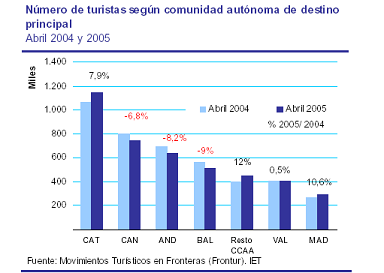
Spain's tourist industry continues to thrive according to figures released today by the Industry, Tourism and Trade Ministry. In the first quarter of 2005 Spain received a record 13.6 million foreign tourists. This represents a five percent increase in international tourism compared to the same period in 2004 and, according to the Ministry, is the first time that more than 13 million tourists have visited Spain during the first four months of any year.

In April Spain received 4.2 million tourists from abroad, considered by the Ministry to be especially encouraging given the fact that this year Easter was in March, as opposed to last year when Holy Week was celebrated during April.

According to data put together by this latest survey carried out by the Ministry, the improved figures are largely thanks to the increase in the number of French tourists travelling to Spain. The UK and Germany are still ahead in terms of number of tourists who come to Spain, but France is closing the gap and comes a close third behind Germany.


Catalunya heads the ranking of most popular Spanish region and in the first quarter 27.4 percent of tourists chose Catalonian destinations on the Costa Brava and inland. The Canary Islands was the second most popular region, followed by Andalucia and the Balearic Islands (light blue 2004, dark blue 2005).


Related links:
Beautiful places in Spain
Spanish paradors

Labels:

Wednesday, May 11, 2005

Spain's third savings bank and General Electric sign deal

Spanish bank Caja de Ahorros del Mediterraneo (CAM) has signed a joint venture deal with US General Electric Consumer Finance worth 468 million Euros.

The joint-venture is called CAMGE Financiera and centers around consumer finance. It is expected to absorb the CAM's currenty consumer finance portfolio worth 1.3 billion euros, including the issue of 630,000 credit cards.

CAMGE Financiera aims to become the leader in Spain's consumer finance in the medium term, by achieving a yearly growth of 20 percent. The new company will initially focus on personal loans and the credit-card business and may later move on to offering car and mortgage loans.

The chairman of General Electric España, Mario Armero, said on Monday that the deal represented the consolidation of GE's "focus on the Spanish market as the center for financial business in the south of Europe," he said. The general manager of CAM, Roberto Lopez, said that Spain's thrid savings bank had found the right partner in terms of strength and experience "to achieve leadership of the consumer finance market in Spain."

GE hopes that the knowledge and international experience of GE Consumer Finance combined with the "sales clout" of the 940 branches will give the formula needed to become leader of the Spanish market. The department store chain El Corte Inglés currently leads the consumer finance market in Spain, followed by Banco Cetelem and then Santander Consumer Finance.

More about Caja de Ahorros del Mediterraneo and Spanish banks.
Mortgages in Spain

Labels:

Thursday, May 05, 2005

Consumer debt in Spain

According to figures released yestoday by the Bank of Spain, the rate of borrowing by consumers in Spain reached an all-time high in 2004. Consumer debt rose last year by 17.5 percent up to 595.183 million euros, a huge 74.5 percent of the Spanish GDP. This means that borrowing in Spain has tripled in eight years. In 1996 it stood at 200.000 million euros.

Long-term loans continued to rise by 20 percent, rising to an overall sum of 502.145 million euros in absolute terms. Experts say that the continued rise in Spanish mortgage loans reflects the steady rise in house prices in Spain and the low rates of interest. Spanish banks do not seem to have heeded the warning given by the Bank of Spain last year to moderate the number of mortgage loans they give to their customers, and interest rates in Spain continue to be amongst the lowest in Europe.

Family financial assets in Spain also rose to historic heights in 2004 to 1.36 billion euros, which is 115,000 million more than the previous year. The net financial wealth of Spanish families also rose by 26,000 million euros with respect to 2003.

Labels:

Monday, March 21, 2005

Petrol prices rise in Spain

Today marks the beginning of Holy Week in Spain, and as every year holiday-makers will flock to the tourist areas to enjoy the first warm days of Spring. But this year people driving to their holiday destination may find themselves exceeding their budget due to the price of petrol here, especially if they drive a gasoil car.

Although Spanish prices are still not as high as in many other European countries, petrol prices are starting to become more and more of an issue here. It costs nearly 6 euros more to fill a 40-litre gasoil tank than it did in Easter last year.

This month oil prices have reached an all-time high in Spain and gasoil now costs 86.4 cents per litre. In April last year a litre cost 76.6 cents. Meanwhile non-leaded petrol 95 costs 90.3 cents and unleaded super 97 costs 98.2 cents.

The alternative to driving is of course to take advantage of some of the special offers launched by airlines running inland flights. Spanair launched another 9 euros per flight campaign this weekend and some of Iberia's special offers start from as low as 15 euros. Infact it has never been as cheap to fly within Spain as it is this year.

Rail travel is another possibility. Spanish long-distance trains are usually comfy and good value for money. First class travel on RENFE and AVE trains is much cheaper in Spain than in Britain, and passangers are served meals and drinks depending on the time of the journey,

Useful links for people planning on spending their Easter holidays in Spain:

Holidays in Spain
Spanish paradors
Hotels in Madrid
Air travel to Spain
Rail travel in Spain

Labels:

Tuesday, March 15, 2005

Spanish government to set up property renting agency

According to figures published by the Youth Council (Consejo de la Juventud) last year, 64 percent of people aged between 18 and 34 in Spain still live with their parents because they can not afford to buy a house and because property available for long-term rent is both scarce and relatively expensive. In an attempt to make more rented accommodation available, the Spanish government proposes to set up an agency to encourage property owners to rent out empty flats and to persuade young people to see renting a property as an economically viable alternative to buying a house.

Details of this new government agency have been released today. It will be called the State Renting Company (La Sociedad Publica de Alquiler) and will rent out privately-owned property on behalf of the property owners. The idea is for owners of empty homes (usually people who have bought property as a medium or long-term investment) to use the company as a kind of renting agency, handing over the right to rent to the agency, and to receive a monthly rent from the agency for a given period, say five years.

This means that owners will not have to look for and interview tenants or chase after any unpaid rent. And they may even be able to claim the five years rent in one lump sum, which is bound to attract lots of people who would otherwise be reluctant to rent out their second or third properties, but seems a bit excessive. Until the Agency finds tenants, the monthly rent paid to owners will be public money. The policy may prove very attractive to non-resident owners of Spanish property who often find it very difficult to rent out property they buy in Spain to long-term tenants, and even more difficult to keep up with monthly rent payments.

The government aims to create a pool of 25,500 properties to rent in Spain over the next four years, and to offer them at a lower monthly rent than the current average so that more young people and low-income families can afford to take this option.

Related links
News on the property market in Spain
Buying a house in Spain
Mortgages in Spain for non-residents

Labels: , ,

Sunday, March 06, 2005

Low mortgage interest rates in Spain boost housing market

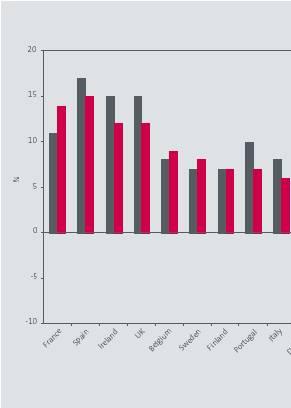
The Royal Institution of Chartered Surveyors (RICS) has just published a study on Europe's housing markets, and concludes that housing prices in Spain, France and Ireland continued to rise by double figures during 2004 and that there is little evidence to suggest that markets could crash in 2005.

The executive summary of the RIC paper says of Spain, France and Ireland, "Each year for the past three or four years pundits have predicted that the following year would herald a market slowdown in the booming residential markets of Europe. Yet, the UK apart, the slowdowns have failed to materialse. Low interest rates, instead, have continued to feed beliefs that capital gains can still be made out of housing and, to an extend, they have become self-reinforcing"

The table below, taken from the RICS Executive Summary, shows the rise in housing prices in European countries in 2003 (grey) and 2004 (red).


Unlike in the UK, low interest rates in Spain have helped to maintain the rise in housing demand, boosted by a steady increase in mortgage loans. Real mortgage interest rates in Spain were negative last year, averaging just 3.49 percent in Autumn 2004, and rates are presently 4 points lower than mortgage rates in the UK. which is one reason why more and more British buyers are choosing to take out a mortgage with a Spanish bank.

The RICS European Housing Review 2005 was put together by Michael Ball, professor of Urban and Property Economics at the Department of Real Estate and Planning at the Business School at Reading University. The full report can be downloaded free from here.

Related:
Latest news and figures on the property market in Spain
Mortgages for non-resident house-buyers in Spain
Spanish banks
Mortgages in Spain

Labels: