Friday, April 20, 2007

Zapatero offers French socialists "model of success"

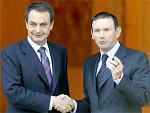
José Luis Rodríguez Zapatero, the Spanish president participated in a large rally in Toulouse yesterday in support of the Socialist candidate for the French presidency, Ségolène Royal. During the meeting, attended by thousands, he said that, Ségolène was the future for France. According to official sources this will be Ségolène’s last rally before the first round of voting on Sunday.

Zapatero said that Europe was waiting for an innovative, committed, brave and modern France to emerge from the elections. He also said that he was convinced that Ségolène would achieve this because she represented a real alternative and would offer another form of government. According to Zapatero Spain feels close to France. His speech, which was translated using subtitles on two giant screens either side of the stage, was greeted with applause and chants of ‘Zapatero, Zapatero’.

When asked why he had chosen to show such strong support to Ségolène he justified his presence saying that he wanted to accompany her in this decisive phase of her campaign because of the commitment to social democratic ideas which they both shared and to offer a model of success to the French.

Ségolène Royal, was given the nickname Zapatera by the press in 2004 when she became the first female president of the region Poitou-Charentes. When she was still competing to be the candidate for the French presidency, she visited Madrid to participate in PSOE’s annual political conference last September, where she had a meeing with Zapatero. The Socialist leader committed her party to following a similar programme of equality designed by Zapatero’s government.

The French opinion polls only show that three out of four voters are still undecided on who to vote for. Although the outcome is still uncertain, latest polls show Nicolas Sarkozy as the front runner and many foreign policy analysts will question Zapatero's very public display of support for the opposition candidate, especially since Franco-Spanish relations and cooperation are vital in the on-going fight against Basque terrorism.

Labels: ,

Thursday, March 22, 2007

Political wing of ETA almost condemns violence

Otegi - "armed struggle an error"

In an interview with a Catalan radio station Arnaldo Otegi, the spokesperson for the illegal Basque political party Batasuna, said that it would be an error to build an independent Basque state using armed struggle because it would be socially and politically impossible to sustain.

However, Otegi avoided direct criticism of ETA, the Basque terrorist organisation, although he repeated that an independent state would not be possible unless it was achieved through democratic means.

Otegi also said that he was sure that ETA was not trying to impose an independent state through its armed struggle but that it used violence because democratic means to achieve independence did not exist.

Otegi affirmed that the objective now was to create a process in which a definitive solution to the conflict could be achieved. He criticised those sectors that insisted that Batasuna condemn ETA’s armed struggle when the opportunity to find a solution to the conflict is there for the taking.

He is reported to have said that ‘at present there are sufficient conditions for creating a situation through honest and sincere dialogue in which a definitive end to the Basque conflict could be achieved’.

The Batasuna spokesperson stated that his organization was going in this direction, although he also warned that such a situation could not be achieved unilaterally by the nationalist left (la izquierda abertzale).

Otegi suggested Batasuna should be legalized immediately because 20 accusations that linked it to ETA and were the reason for it being declared illegal have been discredited. He said that all cases that have reached court have been acquitted.
The director of the nationalist left also denounced powerful interests that try to prevent Batasuna participating in local elections because, according to Otegi, they would achieve very good results. He also said that if Batasuna was not allowed to field candidates in the local elections due to be held on 27th May 2007, that the Basque Country would be the only area in Western Europe where institutions did not represent the votes of its citizens.

Labels: , ,

Friday, March 16, 2007

Equality of sexes in Spain

Spanish Congress passes new equality laws

The Spanish parliament passed the Law on Equality between men and women yesterday. This new law gives fathers the right to 15 days paternity leave and equality between men and women on electoral lists which according to Zapatero, the Spanish president will radically transform society for ever.

The president took it upon himself to present the law on equality in the Spanish Congress today with the support of 192 members of parliament but with the notable abstention of the 119 PP members of parliament. When the law was passed there was a standing ovation by members of parliament and representatives of women’s groups that had been following the debate in the Congress.

The Law on Equality also forces companies with more than 250 employees to negotiate plans on equality within the workplace and for larger companies to incorporate 40% of women in their Board of Directors within 8 years.

It also gives parents the rights to reduce their working day from an eighth to half in order to look after children under eight years old. In the case of premature births, maternity leave starts when the baby leaves the hospital. Paternity leave will be extended from 15 days to one month within a timescale of 6 years.

One of the most controversial changes that the new law will bring about is to electoral lists. In districts of 5000 or more inhabitants political parties must have at least 40% of women for every 5 posts. From 2011 this measure will be applied to districts of 3000 or more inhabitants.

Susana Camarero, a member of PP, accused Zapatero of being an armchair feminist who does not listen to women (even though he is the only president in Spanish history to have an equal number of men and women ministers in his government). She said that this was a law for elites and that it did not address the needs of real people. She also said it was not very ambitious and that it would not be very effective.

Zapatero highlighted that the most important objective was to do justice to women. He dedicated the 15th March 2007 to Clara Campoamor, the member of parliament who defended women’s rights 75 years ago. According to Jesús Caldera, the Minister for Work and Social affairs this new law could come into effect next Monday.

Labels: , , ,

Friday, March 09, 2007

A weekend of protests in Spain begins today

Demonstrations organised by PP to take place all over Spain today

Spain’s main opposition party, the PP, has organized demonstrations to take place all over Spain today in order to show solidarity with the victims of terrorism. The PP has called on all citizens to participate. These smaller demonstrations planned for today will serve as a warm up for tomorrow’s demonstration in Madrid which they hope will attract thousands of demonstrators. The demonstrations are protesting against the government, following the ETA prisoner De Juana Chaos being released from prison and being placed under house arrest.

This decision effectively saved De Juana’s life as it meant that he gave up his hunger strike which had lasted over 100 days. His health was deteriorating rapidly and his vital organs could have stopped working at any moment. He is now recovering in hospital in San Sebastian before returning home where will remain under house arrest for the remaining part of his sentence for threats (he has already served 18 years in prison for his part in over 20 political assassinations).

Some believe the government’s decision has also saved the delicate ‘peace process’ that has been taking place between the government and ETA. If De Juana de Chaos had died the consequence would have been very serious and it is almost certain that street violence ‘calle borroka’ as it is called in the Basque Country would have escalated. The Government has repeatedly called on the PP to stop using terrorism and the victims of terrorist violence as an electoral weapon (local and regional elections are due to be held next month), and has pointed out that several terrorists were given shorter sentences under the PP governments.

However the PP will inevitably try to capitalise on the unpopularity of the Government's decision (according to a survey carried out this week by Cadena Ser, 60 percent of voters disagree with it) and their leaders talk of little else. They have hired 500 buses to transport people to Saturday's protest march in Madrid, Aznar and the current PP leader, Mariano Rajoy, have both taken flowers to a memorial set up to remember the 25 people killed by De Juana, and yesterday the leaders started driving around Madrid in a bus in a bid to publicise their view that the government has given in to blackmail by De Juana Chaos, and to get support for the marches.

The demonstrations today under the banner ‘Freedom in Spain’, will take place today in the three main cities in the Basque Country - Bilbao, San Sebastián and Vitoria - as well as all major towns in Andalucia, Aragon, Asturias, the Canary Islands, Cantabria, Castilla la Mancha and Castilla y Leon, Catalunya, the Comunidad Valenciana, Extremadura, Galicia, the Baleares, the Rioja and Murcia. In all 65 protests have been organised.

Labels: , , ,

Thursday, March 08, 2007

Corruption case in Granada

Town Councillor accused of corruption freed on bail

Manuel Fernández, a PP town councillor for Alhendín in Granada in charge of town planning, was freed on bail following 8 hours interrogation. He is accused of bribery, neglect of duty, extortion and price fixing.

Amongst other charges he is accused of irregularities in the planning and construction of an industrial estate (Marchalhendín) and a residential estate (Novosur) according to his lawyer who spoke to journalists following the councillor’s court appearance.

He has been given 8 days to pay his bail set at 18,000 euros. He pleaded innocent on all charges and defended the legality of his actions. Details of the interrogation have yet to be made public.

The case came to light when PSOE councillors reported several irregularities in his department. PSOE have accused the town hall of ‘losing’ 16 million euros by selling off land for the industrial estate which was valued at 24.25 million euros for just 9 million euros. In addition Manuel Fernández is accused of removing public rights of way valued at 750,000 euros on roads that pass through the estate and handing them over free of charge to the developer.

Related:
Guide to Granada

Labels: ,

Thursday, February 22, 2007

Extremadura challenges new Andalucian Statute

President of Extremadura questions the legality of the new Andalucian statute

Juan Carlos Rodríguez Ibarra, the President of Extremadura, has announced that he will go before the Constitutional Court to question the jurisdiction of the new Andalucian Statute when it comes into effect regarding control over the Guadalquivir river which runs through Extremadura.

He claims that the new Andalucian statute should not have any legal rights over control of the river which runs through both regions, despite an article contained in the new statue which says that it does. President Rodríguez Ibarra told journalists that the Spanish Constitution categorically states that rivers which run through various regions are the sole responsibility of the State - 8 % of the Guadalquivir river runs through Extremadura while the other 92% runs through Andalucia.

Furthermore Ibarra, one of Spain's longest serving and most outspoken regional presidents, said that while he remained president of Extremadura he had no intention to modify his region’s statute, although future presidents could do what they liked.
Meanwhile, a minister for the Andalucian regional government, Gaspar Zarrías responded to Rodriguez Ibarra's declarations, saying that he fully defends the constitutionality of the Andalucan Statute and regrets the attitude taken by the Extremaduran president.

In a press conference in the Andalucian Parliament he stated that Ibarra was wrong on this occasion. According to Gaspar Zarrías the Andalucian Autonomus Statute which was approved in a referendum last Sunday is completely constitutional and marks a before and after in the regional reforms that are taking place within the country.

Labels: , ,

Monday, February 12, 2007

Independence of Judicial system in Spain

77% of Spanish citizens believe that the Spanish justice system is influenced by politics

According to the results of the latest Pulsómetro survey published today by Spain's leading radio station, Cadena Ser, 77% of those questioned do not believe that the Spanish justice system is independent from political influence. Those questioned think the latest example is the challenge to the right of Supreme Court judge Pérez Tremps to participate in the Supreme Court's debate on the constitutionality of the proposed Catalan constitution. Participants in the survey blame both the PP and PSOE in equal measure for trying to manipulate the Justice system in their favour.

According to the results of the survey, two out of three people questioned were in favour of the decision not to free the ETA prisoner Iñaki De Juana Chaos despite his failing health due to his hunger strike. Most people questioned also supported a policy of force feeding him.

When asked about voting intentions PSOE came out in the lead with 43% of votes while the main opposition party in Spain, the PP, got 5 points less at 38% of votes.
With regards to the popularity of the main political leaders in Spain José Luis Rodríguez Zapatero, President of Spain and leader of PSOE, obtained 51% support and Rajoy, Leader of the PP, received just 30%.

Labels: ,

Sunday, February 11, 2007

Secret CIA flights in Spain

Spanish government to declassify documents on secret CIA flights in Spain

The Vice-president María Teresa Fernández de la Vega has announced that all documents concerning illegal secret CIA flights in Spain held by the National Intelligence Centre will be declassified.

This announcement came following the request by the Spanish High Court. De la Vega said that it was essential for the executive to collaborate with the High Court even when if it meant revealing ‘official secrets’.

The illegal CIA flights refer to those flights which transported terrorist suspects to other countries for interrogation where respect for human rights is questionable.

The High Court judge who requested the information, Ismael Moreno, is investigating whether any of these flights made stops in Spanish airports. According to some sources the CIA flights made stops in Tenerife, Barcelona, Palma de Mallorca and Málaga airports.

Labels: , ,

Sunday, January 14, 2007

Government calls for consensus in fight against ETA

The Vice President calls on the PP to support government policy against ETA

In a speech given in Marbella yesterday the Vice President, María Teresa Fernández de la Vega, appealed to the PP (Spain’s main opposition party) to support government policy against ETA on Monday when president is due to appear before Congress.

This appeal comes just a day after thousands marched against ETA in Madrid and Bilbao, demonstrations which were not endorsed by the PP. All other political parties in Spain participated in the demonstrations.

De la Vega stated that the President’s appearance before congress would not include anything extreme that could not be supported by those who wanted to see an end to violence. She also stated that all democratic governments had tried to achieve a peaceful solution and not to do so would be irresponsible.

De la Vega spoke of the intolerable accusations that the PP had made against the government and asked how they could steep so low. She said that it was an insult to suggest that the government did not want to end terrorism against the state and that at no time had the Security or Justice departments lowered their guard.

She said that since May when Zapatero announced the government would be prepared to enter into dialogue with the terrorists the government had worked ceaselessly, responsibly and loyally in order to try and achieve peace. She also said that they had tried to gain the support of the PP because a united front against terrorism is much stronger. She said the government would continue trying to get the support of the PP in spite of the PP’s claims that the government was betraying the victims of terrorism and giving up Navarra.

De la Vega said that she was confident that the PP would support the government in parliament today and that it was a great occasion for all political parties to come together to show their opposition to ETA. She asked for the PP to stop creating divisions in this respect.

At the end of her speech De la Vega said that the Government felt proud of the solidarity shown in the demonstrations against terrorism on Saturday in Bilbao and Madrid. She concluded that if everybody united then peace could be achieved.

Labels: , , , ,

Thursday, January 11, 2007

Anti-terrorism Demonstration in Madrid

The demonstration organised for this Saturday in Madrid to protest against ETA terrorism will keep its slogan ‘For peace and against terrorism’.

The Trade Unions UGT and CC OO (two of the largest in the country) along with the Federation of Equatorians in Spain (the two people killed by the terrorist bomb in Madrid Airport were immigrants from Ecuador) have decided not to include the word ‘Freedom’ in the banner which will be carried at the head of the march, as had been requested by the Ermua Forum. However, by way of a compromise, the main organisers of the march have agreed to include the slogan ‘for life and for freedom’ in the final speech which will be given at the end of the demonstration.

The Spanish governing socialist party PSOE, the left wing IU political party, the United Police Syndicate together with the Association for the 11th March Victims have all given their support to the organisers of Saturday’s march, whereas Mariano Rajoy, leader of the PP, prefered yesterday to outline three conditions which he said must be fulfilled in order for his party to support the demonstration – for it to call for the "defence of freedom", the defeat of ETA and for there to be no negotiations with terrorists.

The pro-PP Association for the Victims of Terrorism has confirmed that it will not be supporting or participating in this Saturday’s demonstration which they claim to be politically biased and in favour of negotiating with terrorists. Instead the leader of this Association has called for people to demonstrate against the bomb explosion in Madrid airport tomorrow.

There is also divided opinion over the demonstration due to take place this Saturday in Bilbao organised by the Basque Government in favour of "peace and dialogue". The Basque Socialists will only support the demonstration if Batasuna is not participating in the march. Patxi López, the General Secretary, explained that they would not participate alongside Batasuna who have still not condemned the bomb planted by ETA in Madrid two weeks ago.

Labels: , ,

Monday, January 08, 2007

Basque separatists appeal to ETA to maintain ceasefire

The leader of Batasuna, the political wing of ETA, Arnaldo Otegi, has requested that ETA respect and maintain the contents and objectives given in their statement on 22nd March 2006 which announced a permanent ceasefire.

In a press conference given in San Sebastián yesterday Arnaldo Otegi along with Rufi Etxeberria and Arantza Santesteban, other members of Batasuna involved in negotiations, asked that political dialogue be allowed to go ahead in the absence of violence.

Furthermore, Otegi assured his commitment to a just and long lasting peace between the Basque Country and the Spanish state.

Batasuna called for all political parties in Spain to participate in the negotiations without preconditions and with no further delays in order to form a solid multilateral base for political dialogue.

In addition Otegi urged both sides involved in the dialogue, ETA and the Spanish government, to publicly show their commitment to the peace process. He asked for central government to guarantee the conditions under which the peace process can proceed in order to find political solutions for the Basque Country.

He also urged ETA to maintain their commitment to the ceasefire announced on 22nd March 2006.

Otegi said he hoped that these requests would receive positive responses from all those involved allowing for the political process to continue in order to reach its final objective a peaceful political solution.

Labels: , ,

Friday, December 29, 2006

Basque peace progress

Less optimism among Basques about the peace process in the Basque country

According to the results of a study carried out by the University of the Basque Country and made public to the media in Spain today, 64 percent of Basque people fear that ETA may kill again and 33 percent no longer believe that the ceasefire called by the terrorist group in March is the first step towards ETA eventually disappearing altogether.

An increase in violent acts being carried out by groups of youngsters in several Basque towns and declarations by members of the political wing of ETA blaming the Spanish government for the lack of progress being made in the peace process are behind the most pessimist study to have been carried out since ETA announced the permanent ceasefire last Spring.

The Basque University measures public opinion with this study - called - twice a year. The results made public today contrast with the results just six months ago, when 86 percent of people said they viewed the peace process with optimism (compared to 62 percent this time), and 61 percent expressed their outright rejection of ETA then, compared to just 50 percent this time.

Related articles:
Basque peace process backed by the European Parliament
Spain's main political parties clash over Basque peace process
Negotiations between government and ETA
Spanish government and ETA negotiate possible ceasefire
Government proposes talks with ETA
Gerry Adams interviewed during his visit to Spain

Update: On Saturday 30th December ETA planted a bomb in one of the carparks in Madrid Airport. Police managed to evacuate 2000 people before the bomb exploded, but two people are missing and feared dead. The bomb was one of the biggest ever used by the Basque terrorist group and signals the end of the ceasefire and, presumably, the peace process.

Labels: , ,

Thursday, December 07, 2006

Reforms in primary education in Spain

The government has announced reforms in primary school education. The new decree is called Minimum Teaching in Primary and will come into force in the next academic year.

The biggest changes with respect to the current system is that primary school pupils will be able to choose whether or not to study Religious Education, and those who choose not to will have the right to study an alternative subject. This is already the case in most state schools, but many private schools with religious connections offer no substitute to the traditional Religious Education classes in Spain, which teach children the ins and outs of Catholic beliefs.

All schools will be obliged to undertake the "organizational measures" necessary to offer the alternative to its pupils, ensuring that no pupils will be discriminated against whether they choose one option or the other. This means that whether or not a student has studied Religious Education will no longer be taken into account when he or she applies for a place at university or a higher education grant.

The other main change in the schools' curricula is in the number of hours dedicated to teaching language, maths and foreign languages. According to the new decree, from next year onwards pupils will receive 45 hours more maths tuition and 25 hours less of Spanish language and literature. A new subject called Citizenship and Human Rights Education will be introduced into the timetable of the fifth or sixth primary years.

Related:
Spanish Catholic Church campaign against Socialist government policies
Education in Spain

Labels:

Thursday, November 02, 2006

Elections in Catalonia

CIU wins Catalonian Regional Elections.

Convergencia i Union, the moderate Catalan separatist party won yesterday's election in Catalonia, although the victory was not big enough for the party to form government. The result represents an important reverse for the Catalonian Socialist Party (PSC) which has governed for the past three years together with two minor left-wing separatist parties, ERC and ICV-EUiA in the coalition government known as the tripartito which has secured increased autonomy and a new constitution for Catalonia.

This was the third time the Catalans have been called to vote in the past three years, and the low turn-out reflected the feelings of a weary electorate. The last regional elections were just three years ago, and earlier this year voters were asked to vote in a referendum on the proposed reforms in the Catalan statute. Yesterday les than 57 percent of the electorate participated in the elections, the second lowest turn-out in the history of Catalonian regional elections.

CiU increased its number of seats in the regional parliament by 2, from 46 to 48, while the PSC lost 5 seats. ERC and the Popular Party also lost one seat each, while the other minor separatist party ICV-EUiA gained 3 seats and a new anti-separatism political party called Ciutadans de Catalunya (Citizens of Catalonia) formed just before the elections won a surprising 3 seats.

The leader of Convergencia i Union, Artur Mas, said last night that his party would start negotiating with other parties to form a coalition government. The only party he has ruled out as a possible partner in a coalition government is the Popular Party.


Related:
Congress debates new Statute for Catalonia
Breakthrough in talks for new Catalan Statute

Labels: ,

Wednesday, October 25, 2006

Basque peace process backed by European Commission

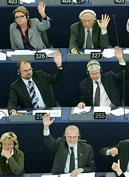
EuroparliamentThe EU member states give their backing to the Basque peace process in Spain

Spain's Socialist government received the support of the European Parliament today as the majority voted to support Rodriguez Zapatero's peace talks with ETA and voted against a resolution put forward by Spanish opposition PP party rejecting talks between government and ETA.

It was a narrow victory - 321 in favour, 311 against and 24 abstentions, but nevertheless a very important one for the Spanish government facing unprecedented opposition from the Popular Party over the whole issue of the peace process. Last week one PP senator accused the PSOE party of surrending to terrorism and initiating conversations with ETA when the terrorists were planning the assessination of an ex-member of the organisation, and government spokesmen called the accusations "vile" while the public prosecutor insinuated that some groups in Spain did not actually want the peace process to succeed.

Both parties have been at loggerheads ever since Zapatero sought the backing of congress to initiate talks with ETA, some months after the terrorists called a ceasefire. Zapatero's appeals to the Popular Party to join all other Spanish parties in supporting the peace talks have fallen on dead ears, and relations have reached yet another low.

The fact that French police believe ETA is responsible for the theft of over 300 military arms this week will add further strength to the argument that the terrorists are getting tired at the lack of progress being made in the peace talks, although some analysts compare it to difficulties in the Northern Ireland peace process when factions of the IRA opposed peace talks.

The debate in the European Parliament was a heated one, but the prevailing view was that the Spanish Government should be allowed to try to achieve peace by negotiation. The European Commission also supported the motion. The EU Justice Commissioner Franco Frattini participated in the debate urging European MPs to back the motion and arguing that Spain's "tenacity and conviction in combating terrorism from the respect of democracy and the rule of law has paid off".


Related:
Spain's main political parties clash over Basque peace process
Negotiations between government and ETA
Spanish government and ETA negotiate possible ceasefire
Government proposes talks with ETA
Gerry Adams interviewed during his visit to Spain

Labels: , ,

Friday, October 20, 2006

Corruption in Spanish politics

Earlier reports that corruption in Spain could be in decline were rather optimistic if the number of possible cases of political corruption being reported by the Spanish media are anything to go by. The list seems to be endless, and every week lately new cases of possible bribes, illegal commission for building licences, unchallenged illegal building developments etc. come to light.

Most of the corruption cases center around real estate speculation and development. Yesterday Cadena Ser reported that Spanish police had found 13,000 illegal constructions in Spain in the past year and a half. Here are just some of the corruption charges in the news at the moment:

Corruption in Marbella: The biggest case of corruption to be uncovered in Spain so far. A police investigation into money laundering and drug trafficking in southern Spain codenamed operation white whale and involving phone tapping overheard conversations between politicians in Marbella which led to a parallel investigation being set up to investigate bribery, corruption, manipulation of public tenders and compensation for illegal building licences. Over 150 police participated in "Operation Malaya" and six months ago over 20 people were arrested, including the then Mayoress and Deputy Mayoress of Marbella. The investigation is still going on, and the profits made by people participating in this massive network of corruption is expected to be millions and millions of euros.

Corruption in Madrid: The authorities of various town halls in the suburbs of Madrid are suspected of accepting commissions for allowing building to be developed on protected land, accepting commissions or being involved in the purchase of cheap land where building is not allowed, then modifying the urban laws so that building becomes legal, and then reselling the land for huge sums of money to property developers. Earlier this week it was revealed that an uncle of the President of the Region of Madrid made an enormous profit on land which was re-catagorised as building land shortly after he bought it a few years ago.

Today El País publishes a conversation held 3 years ago in which a former PP councillor of Tres Cantos, Madrid, in reference to the concession by the Town Hall of a massive property development to a private company is reported as saying "I want my 11 percent of the 30,000 million" (pesetas)"Give me the dough and I'll go". According to el Pais, the ex-PP councillor has acknowleded the declarations but said they were made in the heat of the moment. Meanwhile the same paper today reports that two former mayors of another Madrid suburb, Ciempozuelos, this time from the Socialist party, recently paid 916,000 euros into personal bank accounts in a bank in Andorra. The PSOE party forced the current mayor to resign when the public prosecutor ordered an investigation into possible irregular operations in the urban policies of Ciempozuelos last week and the Socialist party has announced a "Zero-tolerance" policy on urban corruption on all sides.

Corruption in Avila: Earlier this month building on a golf course in Avila was bought to a halt after ecologists protested that the developer - a private company set up by the local and regional administration - was ignoring a court order to stop cutting down trees in a protected area.

And the list goes on.....

Labels:

Wednesday, October 04, 2006

Tony Blair in Madrid

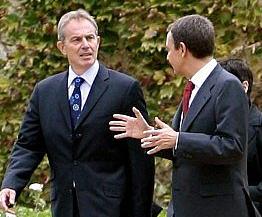
Blair and Zapatero in MadridTony Blair arrived in Madrid yesterday evening for a two-day official visit and gave José Luis Rodriguez Zapatero a boost when he endorsed the Socialist Government's controversial decision to start negotiating with the Basque separatist group ETA. When asked if he supported Zapatero's decision, he said yes, he did, because "it's always worth a try".

Ever since José Luis Rodriguez Zapatero withdrew Spanish troops from Iraq almost as soon as he was sworn in as President of Spain, relations between the Spanish President and British PM have been strained. Especially since Tony Blair enjoyed a very close working and personal relationship with ex-President José Maria Aznar (as he also did of course with Silvio Berlusconi) whom he invited to London after the Spanish election result for what was one of Aznar's last official trips as acting President of Spain.

However, tension has eased over the past couple of years, some progress has been made on the future of Gibraltar, and the Spanish government was quick to offer and supply the British government with help immediately after the London train bombings, when they sent anti-terrorist police and detectives who had successfully investigated the Madrid train bombings to advise their colleagues in the UK.

Yesterday's joint press conference was an illustration of their improved relationship, and both premiers were relaxed as they answered questions. The main Spanish opposition party, the pro-PP section of the Spanish media and even ex-President Aznar have openly criticised the Socialists for their decision to talk to ETA following the ceasefire called by the terrorist group earlier this year.

But yesterday Tony Blair endorsed Zapatero's pro-negotiation policy "it is sometimes difficult, but it is the right thing to do", and offered his support. He also reminded reporters that he was criticised and called naive by certain sectors during the long peace process in Northern Ireland, but "if you believe in it, you just keep going".

José Luis Rodríguez Zapatero thanked the British Prime Minister for his support and confirmed that the peace process in the Basque country would continue but would inevitably suffer lows and reach highs. He refused to confirm or refute the rumour that talks with ETA have reached a deadlock.

Tony Blair's visit concludes today after co-chairing, with Zapatero, a round-table meeting with directors from some of Spain and the UK's top companies, including BP, Vodafone, Barclays, Acciona, Indra, Ferrovial and Telefónica.

Related articles:
Meeting between Blair and Rodriguez Zapatero in Madrid
Gibraltar Agreement signed between British and Spanish governments

Labels: ,

Friday, September 29, 2006

Madrid Summit to discuss illegal immigration

The Foreign and Interior ministers of the 8 EU countries most affected by the arrival of illegal immigrants - France, Italy, Portugal, Greece, Slovenia, Cyprus, Malta and Spain - meet today in Madrid to discuss ways in which to design joint policies and strategies aimed at tackling the growing problem of illegal immigration.

The Spanish government has been trying - unsuccessfully - to pursuade the EU to
become more involved in finding solutions to the problem of immigrants arriving by boats en masse to the Canary Islands and several coastal areas in Southern Spain. The arrival of these kinds of boats has been a problem for some years now, but this Summer it reached acute proportions, leading to appeals for EU help from the Canarian and Spanish governments.

According to reports in Cadena Ser, the Miguel Angel Moratinos, Spanish Foreign Minister, and Alfredo Perez Rubalcaba, Interior Minister, are expected to propose to their EU colleages the creation of a European border police force and coastguard in the summit meeting today. The ministers intend to elaborate a joint proposal to be presented in the EU summit meeting of Home Secretaries scheduled for next month and ultimately to be approved by the Summit of EU heads of state and governments to be held in Finland on 20th October.

Spain will underline the need for a quick, efficient system to be established at coastal borders to replace the current FRONTEX post in waters near the Canary Islands which is deemed by the Spanish government to be insufficient. The French Interior Minister, Nicolas Sarkoxy has announced his intention to propose a "European pact" whereby EU member states pledge not to undertake any mass immigration regulation policies similar to that passed by the Spanish government last year which many believe that, far from solving the problem of illegal immigration, may be one of the reasons why an increasing number of people from North Africa risk their lives in a desperate attempt to reach Spain in small, overcrowded boats.

Related to the problem of immigration in Spain:
2006
Spain appeals to EU for help with illegal immigration
Situation in the Canary Islands worsens
Immigration in Spain
2005
Legalisation of illegal immigrants in Spain
Immigrants on hunger strike in Barclona
Migrants die in border fence crush in Ceuta
2004
New Spanish immigration laws
Reform of Spanish immigration laws

Labels:

Thursday, September 07, 2006

New law to control telecommunications

The government is preparing a new law that will help combat delinquency and terrorism by having a degree of control over telecommunications.

The Spanish Home Office wants to have access to information regarding mobile telephone use and wants companies to make this information available to them by recording information for a period of 12 months. Under exceptional circumstances this could be extended to 24 months.

The law would apply both to pay as you go mobiles as well as those on contract. It would also oblige shops selling pay as you go mobiles to keep a register of their customers. At the moment there are approximately 16 million anonymous mobile phone owners. Investigations into telecommunications played an important part in the detention of 11th March suspects.

Last February the EU passed a law on the retention of information on telecommunications which made operators responsible for keeping information for a period of between 6 to 24 months in an attempt to combat both terrorism and other serious crime. The terrorist attack in London on 7th July 2005 served as an incentive to help get the legislation approved by the member states.

This law applies both to fixed land lines as well as mobile telephones. Companies are required to keep a record of the telephone number from which the call originated, the number where the call is received, the length of the conversation and where the call was made from. Only under certain circumstances can the content of phone calls be made available to the authorities.

Related:
Broadband Internet in Spain
Wireless Internet connection in Malaga
Domestic use of new technologies in Spain
Telefonica Internet services
E-commerce in Spain

Labels:

Wednesday, September 06, 2006

Changes to Traffic Laws

The laws governing traffic have undergone further changes. The introduction of a points system for driving licences came into effect last July and now further changes to penalties for various infractions come into effect as from today.

Not wearing a helmet whilst driving or as a passenger on a motorbike or moped will now be classed as a serious offence whereas it used to be classed as a minor offence. This is also the same for people driving quad bikes which have become very popular in recent years.

Not wearing a safety belt will also be classed as a serious offence. Children will also have to use special car seats according to their size (children under a certain height will either need to use a special car seat or a booster seat). Children are only allowed to use normal safety belts when they reach 135 cms in height.

Pregnant, women will also have to wear a safety belt (under the previous laws governing car security they were exempt). However taxi drivers continue to be exempt from the rules on wearing safety belts while at work.

Baby car seats will no longer be allowed to be placed in the front seat if the car is fitted with airbags unless the airbags have been deactivated.

This year over the summer period there have been 10 deaths less than recorded over the same time last year.

Labels:

Tuesday, August 29, 2006

Ex-Mayor of Marbella on corruption charges

Marisol Yagüe the ex-Mayor of Marbella appeared in court for the second time yesterday. The judge, Miguel Ángel Torres, asked for her to return to court in order to clarify her initial declaration.

The ex-Mayor has been charged along with other council members of corruption on several counts and has remained in prison since 29th March. Some of the charges she faces are neglect of duty and bribery.

Pablo Luna, her defence lawyer, said that she had nothing new to add to her original declaration. The ex-Mayor was transferred from prison to court in a police van and her appearance in court lasted just over an hour. According to Luna Marisol Yagüe is still hoping to be released from prison on health grounds due to the depression she is said to be suffering although 3 requests have already been refused by the judge in this case.

Related:
Visitors guide to Malaga and Marbella
Hotels in Marbella
Hotels in Malaga
Cheap hotels in Malaga
Photos of Marbella

Labels:

Monday, August 14, 2006

Demonstration in favour of self determination for the Basque Country

Thousands of demonstrators marched through the streets of San Sebastian to show their support for Basque self determination yesterday afternoon. Although Batasuna, the banned Basque separatist party in favour of complete independance, had been prevented from organizing the march many of its leaders were present.

It was unclear whether the demonstration would be allowed to go ahead until the last minute. Howver, it finally started at 6pm following a slight delay due to some minor incidents between demonstrators and the Ertaintza (the Basque Police).

Mariano Rajoy, the president of the PP was strongly opposed to allowing the demonstration to take place because he considered it to to have been organized by Batasuna who he believes has close ties with the terrorist organization ETA.

The march coincided with the first day of San Sebastian's fiestas known as 'Semana Grande', one of the busiest days for tourism in San Sebastian.

Articles related to Basque indpendence:
Debate over Basque indpendence in Spain
2005 Basque elections in Spain
2005 election results in Basque Country
Basque nationalism

Resources related to the Basque country:
Guide to Guipuzcoa
San Sebastian
Bilbao
Best restaurants in San Sebastian

Labels: ,

Thursday, August 03, 2006

Spain's parties dispute cause of train accident in Valencia

Spain's two main political parties are at loggerheads as to who is to blame for the tragedy last month in which 43 people were killed when an underground train derailed on the Valencian metro network.

The PP have claimed that the accident was neither preventable nor forseeable and therefore no one individual can be held responsible for the accident. They have ruled out the possibility that the accident could have been caused by a technical failure and that Ferrocarrils de la Generalitat (FGV), the company in charge of maintaining the metro system, had fulfilled all its health and safety requirements prior to the accident.

However the socialist coalition in the Valencian Autonomous government, consisting of the PSPV-PSOE parties, don't agree. They have announced that they will be asking the Valencian courts to investigate whether the Head of transport can be held accountable given that this person is in charge of managing the metro network. They claim that the most important part of a democratic system is that people must be held accountable and in the case of the Valencian underground accident the management of the service failed.

However, both parties agree that the most probable cause of the derailment was excess speed.

Labels:

Monday, July 03, 2006

Penalty points system introduced in Spain

New penalty points driving license system in Spain.

Traffic authorities claimed that the immediate results of the new penalty points system were evident this weekend as the number of deaths in accidents caused by reckless driving fell sharply with respect to the same weekend last year. The Government hopes that the penalty points system will act as a deterrent to dangerous and drunk driving which is so common in Spain.

As from the 1st July all licences have a total of 12 points except in the case of drivers who have been driving for 3 years or less; licenses for those have just 8 points.

Points will be deducted from licenses of drivers caught committing all kinds of driving offences - many new to Spain. Offending drivers will have from 2 to 6 points deducted from their licence according to how serious the offence is (see list of possible offences and number of points deducted). Points can be recuperated for good driving (2 points for drivers who manage not to lose any points for two years), and for attending special refresher theory and road safety courses. Drivers who lose all their points due to repeated offences will have their license taken away for 6 months, if it is the first time, or 12 months if it is the second. They will have to attend special course and retake a driving exam before getting their licence back. When their licence is returned it will have just 8 points.

In theory the maximum points an offender can lose in one day is 8 points, although the new system does give traffic authorities to immediately withdraw the licence if the offence is considered to be extremely serious, i.e. driving under the effects of alcohol or drugs, refusing to do a breathaliser test or driving at over 50 percent the speed limit. This weekend one individual was stopped for driving under the influence of alcohol in Sevilla, and he is thought to have become the first driver to lose all his points (and his licence) at once.

Labels: , ,

Tuesday, June 06, 2006

Spain's main political parties clash over Basque peace process

After endless quibbling about how the Basque peace process should be managed, relations between Spain's governing Socialist Party and the main opposition Popular Party hit yet another low yesterday, when the PP Secretary General, Angel Acebes, accused President Rodriguez Zapatero of sharing the same project as ETA and of giving the terrorists what they wanted. And in a radio interview, Mariano Rajoy claimed that the Government was "in the hands of ETA".

The spokesman of the Socialists responded to the accusations by underlining his party's desire for all political parties to participate in the peace process and insinuated that the declarations reflected internal divisions in the PP, and frustration within party ranks at their leader's performance during the Nation Debate held in parliament last week.

Ever since Zapatero announced his intention to begin talks with the Basque terrorist Group last month, 2 months after ETA called the permanent ceasefire, leaders of the Popular Party have expressed their reticence to any negotiations starting before the terrorist group is dissolved and its members renounce all violence and apologise to the victims of their terrorist acts. Their leader, Mariano Rajoy, said his party would support the process as long as ETA fulfilled these conditions.

Last week during a radio interview Patxi Lopez, leader of the Basque wing of the Socialist Party, said that members of the Basque Socialist Party would hold local preliminary talks with members of the illegal political wing of ETA before Zapatero's programmed appearance in Congress to formally announce the start of peace talks.

The Popular Party immediately withdrew all its support from the peace process and announced its intention to put forward a motion in Congress today to prevent the government from going ahead with negotiations. The text of the PP motion argues that negotation with an illegal terrorist organization is not possible and that the disappearance of ETA should be a necessary condition before any talks are held. No other political party in Congress is expected to support the motion and polls show that the majority of Spaniards support negotiations.

Meanwhile, Sinn Fein leader Gerry Adams has begun a three-day visit to Spain today in a bid to support the Basque peace process. He will visit Madrid, Barcelona and Bilbao. Many political commentators in Spain suspect that Adams has had a key role in persuading ETA to call a permanent cease-fire.

Related:
Negotiations between government and ETA
Spanish government and ETA negotiate possible ceasefire
Government proposes talks with ETA
Gerry Adams interviewed during his visit to Spain

Labels: , ,

Monday, May 29, 2006

New land laws for Spain

On Friday the Spanish cabinet approved the draft of a new land law which the government hopes Hill counteract the real estate speculation which is considered to be one of the main causes of the high price of property in Spain.

The Vice-president, Maria Teresa Fernandez de la Vega, announced that the new law will help to secure more land available for building “vivienda de protección oficial”, i.e. low-cost housing subsidised by public funds and made available to first-time buyers with low salaries. As real estate speculation has escalated in recent years, the availability of this kind of subsidised housing has fallen dramatically.

Fernandez de la Vega said “The new law Hill reinformes public intervention, redefine citizens’ rights and duties, guarentee greater respect for the environment, establish greater funds for vivienda protegida and improve the regulation of public ownership of land”. She said that the law reflected the need to protect citizens from excessive speculation.

The new law will also oblige building promotors to take into account aspects such as energy saving and accessibility.

Related:
Buying property in Spain
Property in Spain

Labels:

Monday, May 22, 2006

Negotations between Spanish Government and Eta

This weekend President José Luis Rodriguez Zapatero announced that in June he intends to inform Parliament of the beginning of talks with Basque terrorist group ETA.

Speaking in a Socialist party rally in the Basque country, Zapatero reminded those present that when ETA announced the ceasefire in Spain a few weeks ago, he said then that the government needed to verify the ceasefire before they could properly initate any peace process. Since then the reports commissioned by the government as well as messages sent out from Basque separatists seem to have persuaded the Spanish President that the ceasefire is real and it is time to start talks with ETA. He will seek the approval of Congress to start negotiating in June.

The announcement was received positively by all Spanish political parties yesterday except for the Popular Party whose vice-president, Angel Acebes, criticised the government for sitting down to negotiate with ETA before the group had been completely disarmed and dissolved. The Association of Victims of Terrorism also criticised the news and announced a protest march in Madrid in June. However representatives of all the other political parties expressed their satisfaction at what they hoped was the first step on the way to a lasting peace in the Basque country.

Presumably in an attempt to appease the more critical factions of the Association of Victims of Terrorism, after announcing the start of talks yesterday, Zapatero said he planned to propose a the insertion of a clause honouring the memory of the victims of terrorism in the the introduction of the Spanish Constitution.

Zapatero also underlined his will to include all political parties in the talks. "Peace and tolerance have to be the fruit of a joint effort. Nobody should try to get ahead of anyone else" .

Related:
ETA ceasefire
Government and ETA negotiate possible ceasefire
Majority in Spain support negotiations with ETA
Eta terrorism

Labels: , , ,

Friday, April 07, 2006

Spain's Defence Minister resigns

Important Government changes in Spain.

Spanish president José Luis Rodriguez Zapatero called a surprise press conference this morning to announce important changes in his government caused by the sudden resignation of former Defence Minister, José Bono.

Zapatero has used the resignation to reshuffle his cabinet. Former Interior Minister (equivalent to Home Secretary), José Antonio Alonso, is to occupy the post of Defence Minister, and he will be replaced in the Interior Ministry by former government Spokesman, Alfredo Perez Rubalcaba. Both Alonso and Rubalcaba are close friends and key party allies of the Spanish president.

Alfredo Perez RubalcabaAlfredo Perez Rubalcaba played a key role in negotiating the support of other political parties in Spanish congress needed by PSOE party in order to form a Socialist government. He has also been a key negotiator in the talks and debate leading up to the Catalan Statute. His immediate task now is to lead the negotiations with ETA and play a key role in the possible peace process resulting from the permanent ceasefire announced by the Basque terrorist group last month.

In the press conference this morning, Zapatero said that José Bono had decided to resign for personal reasons, but that this would not be the end of his political career. It is rumoured that José Bono, one of Spain's most popular (and loudest) politicians, may be chosen by his party to fight the regional elections in Madrid which has been in the hands of the Popular Party for the last 16 years.

The other person to leave the cabinet, also on her own request according to Rodriguez Zapatero, is the Education Minister, María Jesús San Segundo who has never really managed to make her mark on the political scene over the past two years and has preferred to adopt a very low profile despite Education reform being one of the key policies of the present government. She will be substituted in her post by Mercedes Cabrera Calvo-Sotelo, former profesor of the Complutense University in Madrid and current Chair of the Education Reform Parliamentary Committee.

Labels: ,

Monday, April 03, 2006

Spain's Government announces new Scientific Digital Library

Today the Spanish Minister for Education announced the creation of a new digital library to provide the academic community in Spain with immediate access to scientific articles and books. According to the government, the new digital collection will be the largest scientific library in Spain and will provide Spain's 150,000 researchers with access to the knowledge they require for their experiments and study.

This new digital collection will be called the Biblioteca Electrónica de Ciencia y Tecnología (Electronic Library of Science and Technology) and it is expected to cost about 80 million euros. According to the Education Minister, it will have 8,000 data bases and users will be able to consult the online editions of all the world's main scientific journals.

It was not made clear whether the government intends to spend money on the digitisation of these journals, something which has already been carried out in countries where use of Internet is more extended than it still is in Spain, or whether it plans to take advantage of a consolidated digital collection of scientific journals such as Stanford University's Highwire Press by way of a strategic agreement.

The Education Minister, Maria Jesus San Segundo, said today that the aim of the new Scientific Digital Library is to double the number of Spanish researchers who have access to electronic collections. According to the Minister, by next Autumn 150,000 researchers and 50,000 university students will be able to use the new facility.

Labels: ,

Wednesday, March 29, 2006

Mayor arrested in anti-corruption raid in Marbella Town Hall

Spanish police have arrested Marisol Yagüe, Mayoress of Marbella, together with another 18 people, including counsellors, businessmen and lawyers, this morning in an unprecedented raid carried out on the Town Hall. A police spokesman told media that the raids represent the latest step of a long investigation aimed at uncovering a complex network linked to a wide range of criminal acts. Police have searched offices in the town hall, aswell as several private businesses and the homes of Marbella's mayoress and director of urban affairs.

As a result of this morning's operation, over 1000 bank accounts have been blocked. The accused are charged with bribery, prevarication and traffic of influences.

Ever since real estate speculation began in earnest in Marbella with the boom of tourism a few decades ago, urbanistic rules and regulations have been designed, undone and often simply violated at the apparant whim of whoever was in charge at the town hall. The last mayor, Julian Muñoz, was voted out of office two years ago by his own policital party, and is due to make several court appearances to answer various charges related to bribery and corruption.

And his predecessor, Jesus Gil, who was mayor of Marbella for 11 years, was accused of violating urbanistic laws more than 200 times and was eventually given a prison sentence and forbidden from participating in politics for 28 years. When he died 2 years ago, Gil still had numerous court cases pending, and was involved in a constant exchange of accusations with his successor Muñoz.

In 2005, when the current mayoress was already in power, the president of the Andalusian Regional Government, Manuel Chaves, suddenly withdrew all urbanistic powers from Marbella Town Hall and an investigation was launched, resulting in today's operation.

Labels:

Tuesday, March 28, 2006

Spanish PM and leader of the opposition discuss ETA ceasefire

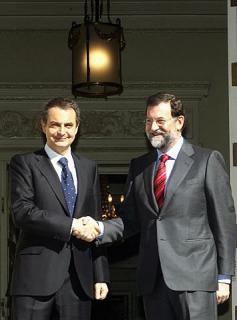
Spain's president Jose Luis Rodriguez Zapatero met this morning with Mariano Rajoy, leader of the Popular Party, in what most sections of the Spanish media are hailing as a possible end to the bitter relations which have existed between Spain's two main parties ever since the Socialists won the 2004 elections following the Madrid train bombings two years ago, a result which many members of the Popular Party still deeply resent today.

Since ETA's permanent ceasefire announcement last week, the narrow gap dividing the two main parties in opinion polls has widened in favour of the PSOE, and as support for Zapatero has grown notably among the Spanish electorate, the Popular Party has started to moderate the aggressive tones its leaders generally use when commenting government policy on just about every possible topic on the political agenda.

Even though the first official reaction of the PP following ETA's announcement was typically scathing, when the leader of the Basque PP Party claimed the ceasefire was the result of the constant concessions made by Zapatero to separatists, since then all except the most radical members of the PP have taken care not to be too critical. Zapatero's gesture last week, when he refused to make any comment to the media about the ceasefire until he had personally informed Congress the same afternoon, and used the occasion to offer full participation in the peace process to all political parties and particularly to the Popular Party, was received in a positive manner by the vast majority of political commentators on all sides of the ideological spectrum. Apparantly King Juan Carlos rang Mariano Rajoy last week to ask him to support any peace process which could result from ETA's initiative. And yesterday for the first time since losing the elections, a press conference called by the PP to comment on the party stance after a session called by the leader to prepare his meeting with the Spanish president today, was chaired by a party moderate, rather than by hardline Acebes.

If today does mark the beginning of a thaw in the difficult relationship between Spain's main parties, then a large section of the electorate and the Spanish media will welcome the news. Both party leaders seemed to acknowledge that fact today when they spoke to the press after their two and a half hour-long meeting. Zapatero told reporters that today represented "a good first step forward after nearly two years of notable differences". Rajoy was more cautious, saying that the only priority right now was that the Government has what it believes is ETA's firm decision to cease all criminal activity. He pledged his party's support "without party or ideological lables" to Zapatero, providing that there would be no concessions to ETA, no violation of current laws, no contact with terrorist or illegal organisations and no violation of Spanish state law.

Labels: , , ,

Wednesday, March 22, 2006

ETA ceasefire

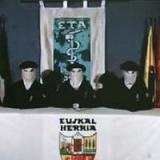
Today at 12.30 ETA announced a permanent ceasefire which will come into effect at midnight on 24th March. See video of ETA announcing ceasefire.

The announcement comes just a day after the Constitutional Courts approved a final text for the new Catalan statute which will be put to the Spanish parliament in the next few weeks.

In a message sent to the Basque newspaper GARA and published in full on the paper's website (see full text of the ETA ceasefire announcement), the Basque terrorist group claims that its leaders have taken this step "to give impulse to a democratic process in Euskal Herria (the Basque Country) to build a new framework within which the rights corresponding to the Basque people are recognised and to ensure a capacity to develop all political options in the future " (the political wing of the Basque terrorist group is currently banned from participating in the political system). "At the end of this process, Basque citizens must have the final word and the right to decide their future".

ETA goes on to say that its members expect the Franch and Spanish states to respect the decisions made by Basque citizens concerning their future and calls for both countries to respond in a positive way to "this new situation" and put repression to one side. The terrorists also call on Basque citizens to get involved in the process and to fight for the rights corresponding to them.

ETA expresses its desire and will for this process to finalise in the creation of a truly democratic situation for the Basque Country, the end of the conflict which has been going on for years, and the construction of a peace based on justice.

"We affirm our commitment to go on taking steps forward in the future in accordance with this will. To overcome the conflict is possible here and now. Such is the desire and the will of ETA".

The Moncloa (Spanish government headquarters) has expressed Zapatero's satisfaction at the announcement, but according to the Cadena Ser, the Spanish prime minister has asked his ministers to be cautious for the moment and to abstain from making declarations. The Spanish Vice-president, Fernandez de la Vega, has also urged caution, although she said she hoped the announcement represented the beginning of the end of violence. Only a couple of weeks ago, Rodriguez Zapatero announced that the end to ETA's violence was near. Other key Spanish politicians have made declarations. The leader of the Basque Popular Party, Maria San Gil, said that the announcement was the result of "continual concessions of Zapatero's Government", while the leader of the Catalan separatists, Artur Mas, told the media he was very happy to hear ETA's promise of a "permanent" ceasefire.

Related:
Spanish government proposes talks with ETA
Spanish government and ETA negotiate possible ceasefire
The majority of Spaniards would support negotiations with ETA

Labels: , ,

Tuesday, January 31, 2006

Politics in Spain

The two main themes which have dominated Spanish politics for the past few weeks - the new Catalan Statute and the anti-smoking legislations - continue to do so, and now that the cold stormy weather which has affected most of Spain over the past few days seems to be letting up, once again media attention is firmly fixed on the outcome of the former, and the effects of the latter.

The Popular Party has started its campaign to collect signatures for a petition designed to force the Goverment to call a national referendum on the issue of constitutional reform and, in particular, the proposed new statute for Catalonia. Yesterday a Euroresidentes colleague received a text message in her mobile phone informing her that it was now possible to vote "in favor of Nation Spain" and encouraging her to do so by entering the Popular Party website, clicking on the appropriate link and electronically signing the petition for a referendum which the PP word in the following way: "Do you believe that Spain should continue to be one nation in which all citizens enjoy the same rights, obligations and access to public services?".

According to the website, 242.000 people have electronically signed the petition in 3 days. Detractors argue that it is relatively easy to inflate the numbers of supposed electronic signatures, especially since the form does not require people to include their address. Yesterday PP leader Mariano Rajoy travelled to Cadiz where he and his fellow party members set up tables to collect signatures in what they announced to be the start of a nationwide campaign.

The implication behind the wording of the petition is, of course, that if the Catalonian statute is passed, then the rights of fellow Spaniards are at risk. And indeed the whole strategy of the Popular Party is centred around the accusation that in acknowledging Catalonia's desire for increased autonomy and negotiating the terms of a new statute, the present Government is putting the whole concept of "Spain" at risk. Not all PP party members are happy with this scaremonger strategy. The leader of the PP Catalan party, Josep Piqué (a "moderate" who served as Minister of Industry and Foreign Secretary under previous PP governments), while criticising the way Zapatero had opted to personally intervene in the process by holding individual meetings behind closed doors, did actually admit last week that the wording of the new proposed statute negotiated by President Rodriguez Zapatero and CiU leader, Artur Mas, the previous weekend was much more feasible than the original proposal. When his opinion was challenged by one of the national PP leaders, Piqué went to Madrid to hand in his resignation, but the PP leader, Mariano Rajoy, persuaded him to stay on as leader. Since then Pique appears to have been silenced, but most commentators allege he is still uneasy with the hardline his party is taking with regard to the whole process of constitutional change.

Meanwhile, José Luis Rodriguez Zapatero appears to have put his foot in it once again, this time with respect to the recent anti-smoking laws in Spain. Even though the general opinion regarding the new legislation seems to be more or less favourable, the extent to which the law restricts smoking in all places of work, public places and restricts the right of newsagents and unlicensed shops to sell tobacco has inevitably been criticised by pro-smoking groups and trade unions. Last week it emerged that during the meeting held between President Zapatero and Artur Mas, both party leaders spent the whole afternoon smoking while they negotiated. Apparantly it was Artur Mas himself who spilt the beans when he told colleagues in surprise that they had "smoked all afternoon" in the Moncloa (headquarters of the Spanish presidency and home to the President and his family) despite new the anti-tobacco restrictions.

The PP have jumped on this latest apparant blunder of the Spanish president and have promised to put a number of questions to the government in a parliamentary session in the near future. A government spokesman, while not denying that "mucho" smoking went on during the meeting, claimed that the meeting was held in private quarters of the Moncloa, in a meeting room looking out onto the gardens on the ground floor of the private presidential residence. Meanwhile, the Popular Party allege that the Moncloa is a place of work, and if Rodriguez Zapatero smokes there during meetings, he is violating the new anti-tobacco laws. The opposition members are expected to ask Elena Salgado, Spain's Health Minister, what measures the government plans to take against people who occupy positions of power within the public administration and continue to violate the new law by smoking while they work.

Labels:

Monday, January 23, 2006

Breakthrough in talks for a new statute for Catalonia, Spain

This weekend President Zapatero appears to have broken the stalemate in which all parties involved in negotiations for increased Catalan autonomy had found themselves for the past month. In what may turn out to be a surprisingly astute move, the Spanish president met with leaders of the moderate CIU Catalan party (moderate, that is, compared with the increasingly radical Esquerra Republicana) and managed to get them to compromise on two key issues which had been source of contention between Catalan separatists and most members of all the other parties of the Spanish national parliament.

The first was the word "nation". The proposal for a new statute presented by all Catalan parties (except the PP whose members remain firmly opposed to any constitutional change in Spain and terribly critical of the Government's policies which, they claim, are "disloyal" to the Spanish state) described Catalonia as a "Nation state" throughout all clauses, which caused an uproar among Spanish mainstream political parties, including many members of the governing socialist party. It also lead to some key military leaders to criticise the process and one general even went as far to say that if the Spanish national constitution was ever threatened, it was the duty of the army to protect it.

Despite the fierce criticism, until now the Catalan socialists and all indpendentist parties had defended their "right" to call Catalonia a nation. But in their meeting with the Spanish president this weekend CIU leaders agreed to modify the text, and refer to Catalonia as "a nation of Spain" in the atricles of the new statute. Catalonia will be described as a "nation" in the introduction but, apparantly, because it is not included as such in the actual articles, this will have no legal significance.

The second big compromise is on fiscal policy. The Catalan separatists were demanding total control over all taxes - income and VAT - aswell as local taxes. This weekend Zapatero proposed a 50/50 solution, whereby central government will administer half of the money generated by income and VAT taxes, and the Catalan government will administer the other half. And this was accepted by the Catalans.

Last night members of the Socialist party expressed their satisfaction with the new agreement, even colourful members such as the President of Extremadura who had strongly condemned the Catalan proposal for a new statute from the moment it was presented to Congress. Last night he told reporters the agreement reached this weekend was a victory for non-nationalists in Spain.

Meanwhile the leader of the Esquerra Republicana, Carod Rovira, said his party would not support the modifications to the text.

Infact this may turn out to be in Zapatero's in the long term. With Esquerra Republicana becoming portrayed more and more as extremists in the Spanish media, the more moderate CIU (who in the past have enjoyed the balance of power in both PSOE and PP national governments) are again gaining ground within Catalunya. And if the Statute is finally approved by Congress with the abstention of the Popular Party and the Catalan left wing separatists, it will be much more difficult for the PP to sustain its claims that Zapatero's government is in the hands of Catalan extremists. It also might be quite an embarrassment for the respective party leaders, Mariano Rajoy and Carod Rovira, who have spent the past two years insulting eachother, to suddenly find themselves voting for the same thing.

So against all odds, at least this morning, it looks like for the first time since what many see as the "pandora's box" of Catalan autonomy was opened, José Luis Rodriguez Zapatero may have (for the moment) gained control of the situation. Although, of course, as is often the case in Spanish politics, it is impossible to predict for how long this will remain the case.

Related:
Support for Spain's government slides away
Basque nationalism
Zapatero announces constitutional reform in Spain

Labels: , ,

Thursday, December 08, 2005

Zapatero to present ultimatum to Blair

According to reports this evening in Cadena Ser, Spanish president José Luis Rodriguez Zapatero plans to present an ultimatum to Blair during his visit to London tomorrow. He is expected to tell the British Prime Minister that Spain is not prepared to approve any EU budget which does not guarentee the right of Spain to receive funds up until 2013.

The latest proposal made by the British presidency of the EU was for Spain to receive funds until 2010. An outright rejection of the proposal by a member state represents a veto. Spain wants the inevitable reduction of EU funds it has received each year ever since it joined the European Union to be a progressive process.

According to the Cadena Ser, Rodriguez Zapatero will also use his meeting with Blair to make a call for more solidarity to be shown by EU states towards the Eastern European countries, to ask for special attention to be paid to immigration policies and to call for greater investment in research, development and innovation.

The meeting between the Spanish and British PMs tomorrow was arranged after the proposal announced by the British presidency of the EU last Monday was overwhelmingly rejected by the European Commission and the vast majority of member states who accused Blair of showing a lack of solidarity with the newest poorer EU member states.

Timothy Garten Ash of the Guardian offers the following outlines for a possible compromise: Britain, in order to get a deal, should offer a bit more off its rebate. Other rich west European countries should be squeezed to contribute a little more. France should also agree to an EU budget review in 2008 or 2009. This would set the course for a further reduction of CAP spending, and send an immediate signal to the Doha round of the world trade talks. New members from central and eastern Europe should accept a small reduction in their budget allocation, though less than the cut proposed by Britain.
Then, probably some time in the early hours of next Saturday morning, after two days of ill-tempered haggling, everyone should go away for Christmas feeling equally unhappy. That is the European way of happiness.

Labels: ,

Thursday, November 03, 2005

Congress debates new Catalan Statute

The leaders of all main Catalan political parties attended yesterday’s long debate in Spain's parliament about whether or not to admit for discussion the proposal of the Catalan government for a new statute giving the region greater autonomous powers.

The whole issue has further divided the two main streams of Spanish politics. The Spanish president, José Luis Rodriguez Zapatero, has given the statute his support, (pending some modifications concerning the fiscal system), whereas the Popular Party claims the Catalan initiative infringes constitutional law and that as such it would be impossible for the Spanish congress to pass the statute without first ammending the Spanish Constitution. And by law, in order to ammend the Constitution, first parliament has to approve the ammendment by a large majority, and then the proposal must be put to the Spanish people in a referendum.

Yesterday, despite the conciliatory tone of the three Catalan leaders who presented their proposal before Congress, all three defended possibly the most controversial aspect of the estatuto: the fact that it refers to Catalonia as a “nation”. This makes Zapatero’s job of convincing public opinion even more difficult than it already is. The Popular Party argues that it is constitutionally impossible to have a nation within a nation, and since the Spanish constitution refers to Spain as a Nation, debate of a statute proposing to change an autonomous “region” into a “nation” is impossible unless the wording of the constitution is changed first and Spain becomes some sort of federal state of nations.

This is one hot potato that Zapatero is going to find hard to juggle with. He said that yesterday that some ammendments would have to be introduced into the proposal, but he insisted that the essence of the statute would remain the same and asserted that “national identity of Catalonia” was “perfectly compatible” with Article II of the Constitution which “considers Spain as the nation of all its people”.

The Spanish president looked tired during yesterday’s debate which started in the morning and went on until late evening. His speech was generally unconvincing and reflected the difficult (some would say impossible) position he is in at the moment. It contrasted sharply with the open optimism and satisfaction of the Catalans and the energetic, if not aggressive, opposition of the PP who are encouraged by latest opinion polls showing that the majority of Spaniards outside Catalonia do not approve of the statute, especially the “nation” part.

The whole concept of Spanish state is still a very sensitive issue in this still relatively young democracy, and despite the president’s boast that his government is not afraid of debate or reform, a lot of Spaniards secretly are very wary of constitutional reform, especially if it touches on sensitive issues. Many Spaniards from the rest of Spain regard Catalonian politics with a mixture of suspicion and unease, relations between Madrid and Barcelona have always been strained, and the leader of the Catalan Separatist Party, Carod Rovira, is very unpopular throughout mainstream Spain. Rodriguez Zapatero may end up having to pay a high price for his firm defence of the ambitious aims of his Catalan allies, upon whom the stability of his government majority depends.

In the end, after over 10 hours of heated debate, Congress voted to accept the Catalan Statute for further discussion, by 197 votes to 146. Only the Popular Party voted against. The plan will now be passed onto the constitutional committee, where it is expected to be amended over the next two months.

Labels: ,

Friday, October 14, 2005

Latin american summit in Spain

Today the 15th Latin American Summit opens in Salamanca with the presence of government representatives from 22 countries.

All week there has been much speculation about the expected attendance of Fidel Castro, but last night the Spanish government announced that the Cuban dictator would not be attending the summit after all. He had been expected to attend, especially since the Latin american heads of state intend to issue a declaration condemning the US trade embargo on Cuba.

However Castro may have made the decision not to attend because he feared being arrested on arrival. Last week Spain's constitutional court ruled that Spanish courts have jurisdiction to investigate crimes against humanity outside Spain and bring suspected perpetrators to trial, even if no Spanish victims are involved. This means that if the Cuban leader came to Spain, anti-Castro groups could file a legal complaint against him for crimes against humanity in Spain's High Court which, in theory, could lead to his arrest. He probably felt safer at home.

The only other Iberoamerican countries not represented in the Salamanca summit are the presidents of Ecuador, Nicaragua, El Salvador and Guatemala who are coordinating relief efforts in their respective countries following the severe damage caused by the hurricane Stan last month. The governments of these four central american countries will be represented by their foreign ministers. The summit will also be attended by representatives of other international organizations, such as Kofi Annan (UN), Josep Borrell (EU), José Miguel Insulza (OAS) among others.

The leaders will debate three main topics and design a document with their conclusions. The first centres around the social-economic reality of the economy in Ibero America and proposals leading up to 2010 aimed at encouraging development and prosperity in the poorest countries; the second tackles the migration problems between countries within America and between Latin America and Europe, and the third deals with the international projection of the iberoamerican community. During the summit Jose Luis Rodriguez Zapatero is expected to announce a Spanish aid package for relief efforts in Central America and a possible joint aid package will also be discussed by leaders.

The summit concludes tomorrow evening.

Labels:

Tuesday, September 27, 2005

Spanish congress to have nursery

The influence women are enjoying during the presidency of Rodriguez Zapatero is not limited to a greater role in government. Whereas more women's toilets had be built in the British Houses of Parliament to accommodate the arrival en-masse of women MPs following Blair's first election victory, the new Spanish women MPs are going even further.

A special parliamentary committee, led by two women, has just approved a motion to set up a nursery within the grounds of the Spanish congress to provide childcare for the young children of people who work there.

The new nursery will open in 2006 with capacity for up to 50 babies and toddlers between 0 and 3 years old. The project has the support of all parliamentary groups except for IU, and all congress administrative staff and their trade union representatives. The cost of the nursery will be covered by Congress.

Another reform recently approved by the Spanish parliament enables women MPs to name a substitute during maternity leave. All women in Spain are automatically given four months maternity leave with full-pay, which they can then extend depending on their professional circumstances, but without pay. Because the socialist party's majority is so slight, votes of all members are essential in key reforms. Apparantly the motion to enable substitutes to participate in debates was introduced by two Socialist women MPs who had to attend Congress and vote on key debates during their official four-month maternity leave.

Labels:

Wednesday, September 14, 2005

Spain wires up Parliament

This week the new-look Spanish congress was unveiled to the media to coincide with the start of the new parliamentary session. The technicians and maintenance workers at Congress have certainly been busy over the Summer break. Each MP has returned to find a brand new computer in his or her seat with full Internet access, email and a new automatic voting system.


All 350 members of congress and government were able to try out the new system yesterday, and most seemed very satisfied according to declarations made afterwards. The whole process of wiring up parliament and installing the computers is part of the plan of Spain's flamboyant President of Congress (a role similar to that of Speaker of the House in the UK), Manuel Marín, to introduce technology and modernise the Spanish parliamentary system. Marin aims to improve working conditions for MPs, reduce the amount of paper they continue to use and introduce Congress to the information society.

In an interview published by El Pais this Summer, Manuel Marin said he wanted to put an end to the continual races along corridors to hand in papers to the General Register - "For God's sake! All this can be done via Intranet! Why are we still running along corridors?"

The computers are equipped with an internal chat system, enabling members to talk with other members of their parliamentary group and other MPs. Each terminal also has access to ADSL so that MPs can plug in their own laptops if they prefer. They also have screens to display videos or documents as required.

Labels: ,

Monday, September 12, 2005

Spain government and ETA negotiate possible cease-fire

According to this morning's edition of El Mundo, the Spanish government and members of Basque terrorist group ETA have been maintaining "indirect" talks since the Summer and ETA has agreed to announce a cease-fire sometime in the next three months.

Spain's president, José Luis Rodriguez Zapatero has repeatedly said that the predisposition of his government to sit at a negotiation table with Basque separatists and consider increased powers for the Basque government depend on ETA first laying down its arms. If the Basque terrorists do announce a cease-fire, Zapatero will probably ask the Spanish congress to give its approval for the government to hold talks with all Basque separatist groups, including ETA, and seek agreement which would establish peace in the Region and the eventual disarmament of the group.

According to the El Mundo headline story, the official line is that "both sides are at the stage of negotiating a possible truce", but that infact ETA has already agreed to do so, and now the negotiations center around the wording of the announcement and when, within the next three months, it should be made. El Mundo claims that talks started moving in the right direction last August, when ETA started to be more positive about making a move which could speed up a possible peace process.

Last week the Spanish president had a meeting with José Ibarretxe in Madrid and both leaders refused to go into any detail about what they discussed. The next day, when asked repeatedly about the contents of the meeting, Ibarretxe replied that he had promised total discretion and meant to keep his word. He asked journalists to understand that for negotiations to have a positive outcome, discretion was necessary. He also said "we are doing something very important".


Labels: , , ,

Friday, August 05, 2005

Spanish Defence Ministry suspends civil guards

Following conversations with President Rodriguez Zapatero yesterday, Spain's Minister of Defence announced the suspension of all the civil guards involved in the incident last week in which a man died allegedly as a result of the beating he received at the hands of the civil guard police in Roquetas de Mar.

Meanwhile more witnesses came forward claiming to have witnessed the beating in which Juan Martínez Galdeano, a farm labourer, was allegedly kicked and punched by at least four guards.

The Defence Ministry has suspended 8 of the 9 civil guards involved in the incident. The ninth is still a cadet and cannot be suspended. The reason given for the sanction is "abusing responsibility and carrying out inhumane, degrading, discriminatory or humilliating practices on people being held in police custody".

Rodriguez Zapatero also had a telephone conversation yesterday with Spain's Interior Minister who had already sanctioned the lieutenant of Roqueta's civil guard for "showing behaviour seriously contrary to the discipline, service or dignity of his institution". Following his conversation with the President, José Antonio Alonso announced that he would appear before congress this month as soon as the investigation being held is able to determine exactly what happened in the time leading up to the man's death.

The lawyer of all nine civil guards claimed this morning that his clients were being "crucified" before trial.

Labels: ,

Tuesday, June 28, 2005

Popular Party lose majority in Galicia

Manuel Fraga The final count of the postal votes sent by Galicians living overseas (mostly in Latin American countries) ended just before midnight last night, and confirmed the results of the elections in Galicia held a week ago.

Manuel Fraga, Spain's most veteran politician and the only politicican still active in Spanish politics to have served Franco, is no longer President of Galicia. The Popular Party needed to win 66 percent of the postal votes in the key Pontevedra constituency to hold on to its overall majority, but in the end they only got 49 percent. For the first time in 16 years, the new regional government will be formed by a coalition between the Socialist party and BNG, the Galician nationalist party.

This result is a great blow for the PP which has always considered Galicia as one of its strongholds, in the same was as the Socialist Party considers Andalucia and Extremadura. Franco was born in Galicia, as were Fraga and the current leader of the Popular Party, Mariano Rajoy, who took a very active part in the election campaign.

Many of the Popular Party's key members were present at the count yesterday, and some threatened to challenge the result because of the fact that hundreds of votes were not taken into account because their envelopes did not have the compulsory date stamp proving they had been sent before the last voting date. In the end, the total number of votes which were discarded would not have been enough to secure an overall majority for the Popular Party, and this morning it is unclear as to whether or not the party will try to challenge the result or not.

Labels:

Monday, June 20, 2005

Galicia elections result

Yesterday the Popular Party won the elections in Galicia, although whether or not it will be able to form a government is still not clear. It will depend on the result of the postal votes of Galicians living abroad whether or not Manuel Fraga will serve a fifth term as President of Galicia's regional government.

Fraga is the only surviving politician who served as a Minister during the Franco dictatorship. Both he and General Franco were born in Galicia. Fraga, who founded the Popular Party and is its honorary president, is now in his eighties and has always been quite a controversial character. He is a friend and admirer of Fidel Castro, he has visited and paid host to on several occasions despite his party's firm anti-Castro policies.

Not known for being particularly liberal or tolerant, Fraga frequently resorts to phrases which many women find offensive. Last week when he was asked to give his opinion on the pre-election polls predicting a fall in the number of PP votes, Fraga said that he didn't find surveys particularly credible, and he compared them to a woman who always lies about the number of men she has slept with. Spain's vice-president María Fernandez de la Vega was outraged and Fraga later apologised if he had caused offence to anybody.

One seat remains to be won, and as the results stand now the Popular Party has 37 seats, the Socialists 25 seats and the Galician Nationalists, 13. This means that if Fraga wins the seat on the strength of the votes cast by Galicians living abroad, then he will have won an extraordinary fifth victory. If the Socialists or Nationalists win it, then they will be able to govern as a coalition.

Because of the close result of these elections, last night all parties claimed victory! The PP leaders said they were confident that the last seat would be theirs once the postal votes are counted next week - many Galicians emigrated to Latin America during the last century and traditionally their vote has favoured the Popular Party. The Socialists (who gained 8 seats) claimed that Galicia had voted for change and the leader of the Galician PSOE said he was ready to form government. And the leader of the BNG Nationalists said that his party was ready to enjoy a much more prominent role in the next regional government.

Labels:

Friday, June 17, 2005

ETA says solution to Basque problem is possible

ETA has sent a letter to the Basque newspaper Gara. It contains many of the contradictions and criticisms characteristic of previous Eta statements, but this one contains a message which the Spanish government may find encouraging.

The terrorist group claims that it is "possible" to find a solution to the "Basque conflict" and says offers its "total disposition" to get involved in a "democratic process, without limits and involving everyone".

In its note, the Basque terrorists urge "Basque agents" to open up new opportunities, and they say that in order to achieve the end of the conflict "it is necessary to build a peace based on justice" achieved by "dialogue and negotiation". The note calls for a democratic process without limits and including all involved parties to be initiated. It underlines the fact that any solution must include the self-determination of the Basque people.

A considerable part of the communication is dedicated to criticising Spain's Socialist Government and also the Anti-terrorism pact (from which the Popular Party withdrew last month) and the PNV party which it critices for putting party interests before the interests of the Basque country.

Finally, ETA accuses the Government of "taking steps remimiscent of the darkest times under Gonzalez" (in reference to ex-President Felipe Gonzalez). The Basques also accuse the Government of applying the usual strategies based on police operations, strategies which, according to the terrorists, makes the possibility of a lasting peace more distant.

Spain's vice-president, Maria Teresa Fernandez de la Vega was asked to comment on the ETA communication during a press conference today. She said repeatedly that the Government would only be prepared to make a comment on an ETA communication if it announced the commitment of the terrorist group to put an end to violence and to disappear.

Labels: , ,

Monday, May 23, 2005

Basque parliament votes new leader

For the first time in Basque parliamentary history, a woman has been chosen by members of the regional parliament to preside over parliamentary sessions during the next four years. Her name is Izaskun Bilbao and she is a member of the PNV nationalist party.

According to constitutional law in Spain, the first step towards forming a new government after elections have been held is the election of the parliamentary chairperson, equivalent to Leader of the House. Once the leader has been chosen, then members can get round to voting for a president of government.

Last week the new Basque parliament met on Monday, Tuesday and Thursday and voted no less than nine times, but on each occasion the candidates of the two main parties, PNV and the Basque Socialist Party, PSV, drew the same number of votes. This was because the Basque Communist Party, EHAK, (supported from the sidelines by ETA's illegalised political faction) refused to support the PNV unless the party changed its candidate, Jose Maria Atuxta, who led the house during the previous government.

At first the PNV refused to budge, but when the abstention strategy of the Basque communists looked likely to force yet another tie this morning, Atuxta stepped down in favour of Izaskun Bilbao, one of his closest collaborators, who was promptly voted in with a comfortable majority thanks to the votes of the 9 members of EHAK.

This latest event illustrates just how precarious the new Basque government may prove to be as it will have to resort to all kinds of pacts and agreements in order to push policies through. It is also a worrying indication of the extent to which the influence of ETA's political wing has increased, albeit indirectly, since the recent Basque regional elections.

Labels:

Tuesday, May 17, 2005

Government in Spain proposes talks with ETA

After what has possibly been the bitterest week so far in Spanish politics with the split between Spain's two major political parties becoming wider and wider everytime a member from either party opens his or her mouth, Spanish members of parliament are expected to vote today in favor of the Socialist government's proposal to start talks with ETA if the Basque terrorist group agrees to drop all violent activity.

Last week was Spain's yearly Debate of the Nation, during which the President of Spain explains his government's policies and answers questions put to him by all parties for two days. After a series of bitter exchanges on the first day of the debate, during which the leader of the opposition party, Mariano Rajoy, accused the Socialist party of betraying the victims of ETA, the Popular Party formally withdrew its support from the anti-terrorism pact which has existed between Spain's two major parties for the past few years. The style of Rajoy during the debate was so reminiscent of that of ex-President Aznar that at one moment during one of his answers, President Rodriguez Zapatero referred to the PP leader as "Señor Aznar" by mistake.

According to a poll published yesterday by Cadena Ser, and despite frequent blunders made by this inexperienced government, Spaniards continue to prefer the moderation and messages of respect for political opponents and consensus of Zapatero to the often ruthlessly agressive style of the leaders of the opposition, and the the Spanish President's popularity has risen higher as a result of last weeks debate.

This is going to be a very complicated year for the Spanish government which needs the support of the Popular Party in order to fulfill one of its most controversial electoral promises: modification of the Spanish Constitution. Rodriguez Zapatero has pledged to inform all parties of any meetings with Basque separatists and if, as expected, the Spanish congress approves the government's motion to offer dialogue to ETA if the terrorists drop their weapons, the rift between the parties will probably become even wider (members of the Popular Party are the only representatives expected to vote against the motion).

For the results of any future negotiations between the Spanish government and Basque separatists to have any real meaning, Spain's main political parties will need to show a united front. However, relations between the two parties are at an all-time low, and it is difficult to see just how (or if) they will get out of the present rut.

Labels: , , , ,

Thursday, April 21, 2005

Gay marriages legalised in Spain

The Spanish congress will pass two bills today on two major social issues: legalisation of marriage between homosexuals and divorce. Spanish MPs are debating both laws this morning, and will vote on them after each debate. Both are expected to receive a majority vote in favour, although the Popular and the Catalan CIU parties have announced their intention to vote against gay marriages.

1. New legislation to permit gay marriages in Spain

The bill proposed to legalise marriage between gays is brief and simply indicates the modification of a sentence in the 44th article of the Civil Code which states that marriage is an act carried out between "husband and wife". The government wants to change these last 3 words to "two partners".

Congress is expected to pass both laws, despite fierce opposition to the latter from religious circles. In a rare display of interfaith fraternity, the main religious groups in Spain (Catholic, Protestant, Jewish and Orthodox churches) have signed a joint document asking the Spanish parliament not to pass the law which would legalise marriage between gays. In the document the churches claim that heterosexual, monogamous marriage forms part of the Jewish-Christian tradition.

The new law is not expected to endear the Spanish socialist government to the new Pope, who is known to share his predecessor's rather conservative views regarding alternative religions and modern social issues.

2. New legislation regarding Divorce in Spain

Some changes have been made to this bill since the first proposal for reform was put forward by Spain's Socialist government. Whereas the first draft included a proposal to accept divorce applications just 10 days after a wedding, the new bill extends the minimum period to 3 months (still a big difference from the current one year minimum). Spanish citizens will no longer have to be legally separated before applying for divorce and for the first time ever the Spanish government will provide funds to cover monthly payments for children whose absent parents fail to pay them.

One of the most controversial aspects of the new divorce law is the right of judges to determine joint custody regardless of whether the parents agree or not. Until now custody has always gone automatically to the children's mother unless both ex-partners express their joint wish to share custody or the father is able to prove the mother to be unfit to care for her children.

Labels:

Wednesday, April 20, 2005

Brussels sets visit to Spain to discuss Valencia land laws

Following a meeting of the European Parliamentary Committee on Petitions yesterday, the European Commission confirmed that Brussels will send a delegation of European MPs to Valencia, Spain, to discuss the controversial Valencian Land Laws.

According to Alicante's provincial newspaper, Diario El Información, the delegation will visit Spain between 31st May and 4th June and will meet with members of Valencia's regional government to discuss the possibility of EU sanctions being taken if the Government does not modify the land laws.

The delegation, led by British member of the European Parliament David Lowe, hopes to meet with the President of the Valencian government, Francisco Camps, to discuss how the LRAU could be modified in order to prevent what property owners and the European Parliament consider to be abuses.

Members of the delegation will also meet with the organization Abusos Urbanisticos No.

Related:
European Commission criticises Valencia land laws
Buying property in Spain

Labels:

Monday, April 18, 2005

Basque nationalists win narrow victory in regional elections

Regional elections in Spain.

The Basque nationalist PNV-EA alliance won the elections held in the Basque Region yesterday, but only by a small margin, losing their overall majority. PNV-EA won 29 seats (4 less than in the previous elections), the Socialists came second with 18 seats (an increase of 5 seats), the Popular Party third with 15 seats (compared to 19 in the last elections). The controversial PCTV won an unprecedented 9 seats.

Although Ibarretxe was defiant in his victory speach yesterday, the results are a blow to his party and to his plan for greater autonomy in the Basque region. The regional president repeatedly insinuated that if the Basques gave him their vote in these elections, they would in effect be endorsing Ibarretxe Plan. But what has infact happend is that the PNV-EA have lost 4 seats in the Basque parliament and for the first time in democratic history, the Socialist and Popular Parties have more seats together than the nationalist party and, in theory, could form a minority government together although, given the profound distance and mistrust which exists between them in national politics at the moment, this is unlikely.

Last night both PNV and the Basque socialists claimed victory, but the real surprise of these elections was the low turnout (Basques usually turn out in large numbers to vote in the regional elections, but participation yesterday dropped from 79 percent in 2001 to 69 percent) and the performance of the new Basque Communist Party. The Batasuna party, outlawed because of its ties with ETA, urged its supporters to back the PCTV and yesterday, the communist nationalists outperformed Batasuna's results of 2001 when ETA's political wing won 7 seats.

Prior to the Basque elections, another new policital party, Aukera Guztiak, was banned from participating because of alleged links to Batasuna. When the banned party and Batasuna then encouraged their voters to vote for PCTV, the PP urged Rodriguez Zapatero to force a ban on the communist party, but after holding an investigation, Spain's state lawyers and Fiscal ruled that it was impossible to prove links between the communists and outlawed Batasuna. Spain's Vice President said that in a democratic state, political parties could not be banned from participating in democratic elections on the basis of suspicion. Last night the Popular Party, following its first major setback in Basque elections in recent years, launched a furious attack at the Socialist government, claiming that thanks to the Socialists, ETA were the real winners of these elections.

Ibarretxe could decide to form a minority government, or could even ask the communist party to join him. It is not clear at this stage which option he will pursue. Either way he is going to have to rely on the votes of the PCTV in order to push his policies through regional parliament, and even he will have to admit that his presidency of the Basque government is weaker as a result of these elections. The Basques have not given the Plan Ibarretxe the endorsement he needed to press ahead with his plan.

Related:
Basque elections in Spain
Basque independence, parliamentary debate

Labels: ,

Friday, April 15, 2005

Valencian land laws unconstitutional according to EC

The European Commission has threatened to sanction Spain because of the controversial land laws of the Valencian regional government. The EC claims that the LRAU, as the Valencian land laws are called, fail to respect European Community Law governing procedures that should be used when giving public contracts for major urban developments.

The EC criticises the fact that the Valencian regional and municipal authorities do not publish tenders in the BOE (Spain's official state bulletin where all state tenders, nominations, exam results etc. must be published) or in the Official European Journal which publishes all public tenders held in member states.

According to the EC, failure to publish tenders in both official publications has led to "opaque and damaging actions being carried out against the interests of the landowners". The verdict has been made in response to a legal charge submitted to the European Commission by the organization "Abusos Urbanisticos No" which was formed to fight the Valencian law and has 15,000 members, most of them owners of property whose land has been or could be affected by the LRAU. In the next few weeks a number of Euro-MPs are going to visit the Valencian Region to meet with members of the organisation aswell as with members of the Valencian Regional Government who, until now, had refused to modify the land law.

The website of the British Embassy in Spain offers the following warning to potential buyers of property in Spain: "Buyers of property in the Valencian Autonomous Community should be aware that under the Valencian Government’s Ley Reguladora de la Actividad Urbanística of 1994, all land may be converted for property development, unless it has been deemed no urbanizable on historical, cultural or ecological grounds. This means that even suelo rústico (rural land) may be re-designated as fit for property development if the town hall approves a developer’s plan for such change of use. Land classed as urbanizable is also, by definition, appropriate for development. It is therefore important, when buying property, to check future development plans at the town hall. This is also advisable even where land is already deemed to be urbano, since only by checking the status of the property can one become aware of the implications of likely future developments".

The European Commission has sent the Spanish government a 13-page long report explaining its verdict and has given authorities 2 months to respond. Meanwhile, the regional Valencian Territorial Department released a statement yesterday saying that the EC report confirmed the need to design a new urban law which, according to the statement, the regional government has been working on for the past few months.

Related links:
Buying property in Spain

Labels:

Friday, April 01, 2005

Basque elections in Spain

The Basque regional election campaign officially kicks off today, although the "unofficial" campaign has been raging on for weeks now, ever since Basque President Ibarretxe appeared before the Spanish Congress to explain his plan for a more autonomous Basque government.

Political commentators in Spain see this as a crucial election because the result will be the first real measure of the degree of support among Basque voters for the Plan Ibarretxe (as it is known here). If he wins a significant majority, Ibarretxe will feel further vindicated in his crusade to push his plan forward, despite the fact that the Spanish courts and parliament have ruled out as inconstitutional. And the Spanish government will feel under increased pressure to start constructive talks with the new PNV government (again, if Ibarretxe wins a significant majority) towards finding a solution which is politically acceptable both in Spain and in the Basque Region.

According to the results of a survey published by Cadena Ser this morning, the present Basque government would get a 45-percent overall majority with the two coalition partners (PNV and EA) winning 38-39 seats in the regional parliament. The Basque wing of the Socialist party would win 21 percent (17-18 seats), an increase of three points with respect to the last elections in the Basque Region, and the Popular Party 17 percent (13-14 seats), 6 points less than in the last elections.

Five percent of the Basques who participated in the survey said they would vote for Aukera Guztiak, the party illegalised by the Spanish Supreme Courts earlier this week because of alleged links to the armed separatist group ETA or to ETA's political wing, the illegalised party Batasuna. The fact that they have been prevented of voting for the party of their choice will presumably favour the nationalist PNV and EA parties even further.

Update: Results of Basque elections
Related stories:
The Plan Ibarretxe
Basque independence debate in Spanish Congress

Labels:

Thursday, March 17, 2005

Spanish government orders removal of General Franco statue

In the early hours of this morning the last statue of Franco which had stood in the Plaza San Juan in the administrative center of Madrid was quietly removed and transported to an unknown location for storage.

Spain's Employment Minister confirmed that his Ministry had given the order for the statue to be removed, reflecting what he called "a reasonable decision in a democratic state".

cadena ser franco statue removal

The statue was of Franco sitting on a horse had stood outside the incredibly ugly new ministries buildings since 1959. It was seven and a half metres high and workmen took two hours to dislodge it during the night.

Spanish national police were on hand to avoid any violent incidents, but in the end very few people turned up to witness the last statue of the Spanish dictator disapper into a lorry and be driven away.

Labels: ,

Tuesday, March 15, 2005

Spanish government to set up property renting agency

According to figures published by the Youth Council (Consejo de la Juventud) last year, 64 percent of people aged between 18 and 34 in Spain still live with their parents because they can not afford to buy a house and because property available for long-term rent is both scarce and relatively expensive. In an attempt to make more rented accommodation available, the Spanish government proposes to set up an agency to encourage property owners to rent out empty flats and to persuade young people to see renting a property as an economically viable alternative to buying a house.

Details of this new government agency have been released today. It will be called the State Renting Company (La Sociedad Publica de Alquiler) and will rent out privately-owned property on behalf of the property owners. The idea is for owners of empty homes (usually people who have bought property as a medium or long-term investment) to use the company as a kind of renting agency, handing over the right to rent to the agency, and to receive a monthly rent from the agency for a given period, say five years.

This means that owners will not have to look for and interview tenants or chase after any unpaid rent. And they may even be able to claim the five years rent in one lump sum, which is bound to attract lots of people who would otherwise be reluctant to rent out their second or third properties, but seems a bit excessive. Until the Agency finds tenants, the monthly rent paid to owners will be public money. The policy may prove very attractive to non-resident owners of Spanish property who often find it very difficult to rent out property they buy in Spain to long-term tenants, and even more difficult to keep up with monthly rent payments.

The government aims to create a pool of 25,500 properties to rent in Spain over the next four years, and to offer them at a lower monthly rent than the current average so that more young people and low-income families can afford to take this option.

Related links
News on the property market in Spain
Buying a house in Spain
Mortgages in Spain for non-residents

Labels: , ,

Monday, March 14, 2005

G5 Interior Ministers anti-terrorism summit in Granada

The interior ministers of Spain, France, Britain, Germany and Italy meet in Granada today for a two day summit to discuss how to collaborate more in their response to terrorism. The ministers are expected to sign a joint declaration tomorrow against terrorism in which they will draw a clear line between fundamentalist terrorism and Islam.

This is the sixth time the G5 ministers have met to discuss ways of strengthening security by exchanging information on suspects, simplifying extradition procedures and allowing access to each other's data bases on terrorism and organised crime.

According to Spanish sources, one of the lessons learned from the investigations into the 11-S and 11-M terrorist attacks was the need to coordinate the monitoring of movements of suspected terrorists who up until then had been able to move with relative ease around Europe as they planned the attacks. The interior ministers will explore ways of preventing this from happening again and disuss how to give Europol more power so that it can play a more effective role in monitoring terrorism and crime in Europe.

Labels: , ,

Friday, March 26, 2004

Aznar's last meeting with Europe's leaders

Aznar attended his last meeting with European leaders today, when the EU met to discuss issues related to the new European Union Constitution and terrorism. According to el Pais, European leaders have appealed to the United Nations to adopt a greater role in the transition of Iraq.

Aznar has appeared in a press conference after the meeting to reiterate his position against withdrawing Spanish troops from Iraq. He repeated that governments should not be seen to be giving in to terrorism - despite the fact that international public opinion is increasingly rejecting the thesis that Zapatero will take a soft line on terrorism and is accepting the fact that his decision to withdraw troops from Iraq was part of the PSOE manifesto long before the terrorist attacks in Madrid. Spanish troops will remain in Iraq under the Socialist government if the United Nations is in control of the transition by June.

Yesterday, in his first meeting with Zapatero since the elections (and, as many Spanish reporters stated today, in the first meeting to be conceded to Zapatero by the Spanish President in the past 14 months even though the Socialist leader asked to have an audience with Spain's outgoing President on various occasions last year), Aznar asked the future President of Spain to submit in writing his opinion about what should happen next month when the Spanish soldiers in Iraq should be relieved by colleages from Spain. The future Defense Minister, Jose Bono, has said today that it is the first time that an outgoing government has ever asked for a written document to determine an incoming government's policy on something which has already been decided anyway.

Today the PSOE held its first executive meeting since the last elections. Zapatero repeated his determination to respect all opinions, whether or not they coincide with Socialist policies, but he rejected the thesis that the Spanish electorate's vote was determined by terrorism.

Meanwhile, just when Spring appeared to have arrived in Spain, suddenly the weather has taken a turn for the worse and there is snow on mountains overlooking Alicante. Bad weather is expected to continue for at least two days, and for the next week weather will be unsettled, so all holidaymakers planning on coming to the Mediterranean for their Easter holidays are advised to include at least one jersey and a waterproof in their suitcase.

Labels:

Sunday, March 21, 2004

Spain's new Government will be sworn in in April

Jesus Caldera, one of Jose Luis Rodriguez Zapatero's closest colleagues and the MP responsible for negotiating the transfer of power from the Popular Party to the recently elected PSOE, said today that the new Government would be sworn in between 22nd and 28th April, if not before (see El Mundo).

According to El Pais, the dinamite used in the terrorist attacks in Madrid last week was robbed from a mine in Asturias last month. It is thought that a Spanish person exchanged some explosives for drugs He reportedly received drugs in return. According to the paper, he insists he only led the Moroccans to the warehouse and did not help with the robbery or know the Moroccans had Islamic extremist links.


Labels:

Monday, March 15, 2004

Spanish elections: Democracy wins.

Last night Spanish voters taught the Popular Party a lesson they won't forget easily and used democracy's best tool to express their disagreement with their government and their desire for change and for a credible system. In a historic result, which we all found difficult to believe as we watched the television, and with a massive turnout of voters - 78% - the Spanish electorate defied all the predictions and pre-election polls. PSOE won 42.64% of the vote and the Popular Party just 37.64%, - 7% less than in 2000. Never before in Spain has a government with an absolute majority lost the elections in Spain.

This morning the Spanish media are all talking or writing about the historic nature of this election result and all tend to agree that the Popular Party has been punished by Spanish voters for the way they handled the aftermath of the terrorist attack on Madrid last week. Just before midnight Spain's new President appeared before the camaras and pledged to form a government based on respect, dialogue, transparency and integration. Zapatero has pledged to withdraw Spain's 1,300 troops from Iraq if the United Nations does not take control by June 30 (this was a promise he made in his election manifesto), and has promised to look to look towards Europe rather than USA when defining foreign policy. He has also promised to include all political parties in the fight against terrorism.

Some international press reports have expressed the worry that if it is confirmed that the radical Islamic terrorist group Al Qaeda was behind the bombing last week, then it will be the first time that this group has affected the outcome of democratic elections ("If al-Qaeda was responsible for Thursday's attacks, it appears to have had significant influence in changing the government of a leading Western democracy" BBC; "Did al Qaeda hijack Spain poll?" CNN.

Al Qaeda did not determine yesterday's election result. Spaniards have used these elections to punish the outgoing Government for its handling of the investigation of the train bombings. A democratic government must never be allowed to play political games with terrorism, and this is what a large percentage of the electorate felt their government was doing. Until last week, analysts and pre-election polls suggested that PP would lose their absolute majority, but would still win the elections. They only have themselves to blame for their defeat.

Labels:

Sunday, March 14, 2004

Spain elections - bigger turnout confirmed

Spain's Interior Ministry has released the first voting figures of the day. So far 41,02% of Spain's electorate have voted, almost 4 percent higher than the figure at the same time in the last general elections. Polling stations are open all day until 8.00 this evening.

Labels:

Election turnout - higher than usual

Spain usually has a higher turnout than other West European countries at elections, partly because so many adults remember what it feels like to live in a dictatorship and be deprived of the right to vote. Today more people than ever are expected to vote, because events of last week are likely to drive the youngest voters (many of whom chose not to vote in the last elections) to the polling stations.

Labels:

Election Day in Spain

It is difficult to predict the outcome of todays elections. Never before in the history of Spains young democracy has an overall majority government lost the elections. But these elections are being held in unique circumstances, with Spain still mourning the victims of Thursdays bombing, and the present government coming increasingly under attack for the way in which it has addressed the crisis.

You could never say that the Popular Party has been a transparent party in the face of disaster. During events like the Prestige (the oil spill along the northern coast of Spain last year) government spokesmen and ministers were accused of misleading the population about the extent of the crisis and never acknowledged - and much less apologised for - shocking mismanagement of the first few days of the crisis. They refused to put the participation of spanish troops in the war against Iraq to a parliamentary vote and Aznar is the only ally leader who has refused point blank to discuss the fact that no weapons of mass destruction have been discovered in Iraq. And only two weeks ago, articles appeared in el Pais and Cadena Ser accusing the government of covering up information related to the death of 60 Spanish soldiers last year, when their plane bringing them home from Afghanistan crashed in Turkey.

The Spanish government has been reluctant to confirm evidence suggesting that ETA was not behind the terrorist attack in Madrid last week. So much so that the official line all day yesterday, until early evening, was that they still suspected the Basque terrorist group. The government has used the fight against ETA as the basis of its election campaign, accusing the opposition of taking a weak stance on Basque terrorism and criticising alliances between Socialists and Regionalist parties which have produced governments such as the one in Catalonia. If the bombs last week had been planted by ETA, the reflex reaction of thousands of Spaniards would probably have been to vote PP today.

Feeling here today is that the spontaneous protests outside PP headquarters all over Spain yesterday forced the government to give new information about the arrest of 3 Moroccan and 2 Indian men in relation to the bombing yesterday evening. And in the early hours of this morning, the Interior Minister Angel Acebes said police had recovered a videotape. 'It's a claim made by a man in Arabic with a Moroccan accent. He makes the declaration in the name of someone who says he is the military spokesman of al- Qaeda in Europe.'


Labels:

Wednesday, March 10, 2004

Elections in Spain - Antonio Banderas.
According to the Cadena Ser, Spain's most popular radio station, Antonio Banderas has declared publically his support for the Socialist party ahead of the Spanish elections this weekend. In an email sent to the Socialist President of Andalucia (up for re-election), Banderas encourages him and his Socialist party to continue with their projects and sends his best wishes from the world of culture which, in his opinion, needs them (the socialists).

Labels:

Friday, March 05, 2004

Spanish elections.
According to a Guardian article published today, support for Spain's ruling Popular Party is starting to ebb away and its lead over the opposition Socialists has fallen to 5-7 points. It will be very difficult for the Socialist Party to win the elections, not least because the government controls almost all the Spanish media - tv and radio stations and most newspapers - and they use this control to manipulate news items as much as possible. And while it is true that the polls do show that PP support seems to have reached its peak, and the socialists are gaining ground, it would be a surprise for everyone if the elections this month produce a change in the national Government in Spain.

Labels: