Guernica (Province of Vizcaya)
 .JPG) Guernica
(Gernika y Lumo in Basque), a small
town in the heart of the Basque country,
was the ancient capital of the Basque
country and a symbol of resistence and
independence for Basque people. The
Basque laws were written in the shade
of the famous Guernica oak tree, under
which traditionally the local politicians
held their assemblies.
Guernica
(Gernika y Lumo in Basque), a small
town in the heart of the Basque country,
was the ancient capital of the Basque
country and a symbol of resistence and
independence for Basque people. The
Basque laws were written in the shade
of the famous Guernica oak tree, under
which traditionally the local politicians
held their assemblies.
Guernica became a symbol for peace activists after the horrendous bombing carried out by the German airforce during the Spanish civil. The Basques had shown firm resistence to Franco's troops throughout the war, and in April 1937 Franco allowed Hitler's Luftwaffe to carry out the World's first ever aerial bombing raid over civilian targets. The German and Italian armies chose Guernica to carry out their experiment of aggressive aeriel bombing, partly to send out a message to Franco's opponents, and partly because the town had not been damaged at all during the Spanish Civil War, so that the results of the bombing raid would be more easily ascertained.
.JPG)
The German Condor Legion attacked the
town on a market day when the streets
were full. The town was defenceless
as it was in an area considered to be
relatively safe during the Civil War.
The aircraft's bombs flattened the small
town, killing about 1,654 civilians
and leaving 889 wounded during a relentless
series of strikes which went on for
hours. Most of the people killed were
women, children and elderly who had
been unable to escape from the bombs
themselves or from the fire which burnt
throughout the town as a result of the
raids. Franco claimed that the destruction
had been caused by the Republican army,
but it was evident that neither the
Republicans nor the Nationalists had
the capacity to wage war of this nature.
The day after the bombing of Guernica,
bomb shells engraved with the German
eagle were found in the devastated town.
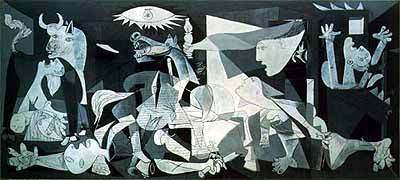 The attack provoked
worldwide indignation and inspired Pablo
Picasso to paint one of his most famous
paintings, Guernica. Even today Guernica
remains a symbol for peace and against
the destruction caused by war.
The attack provoked
worldwide indignation and inspired Pablo
Picasso to paint one of his most famous
paintings, Guernica. Even today Guernica
remains a symbol for peace and against
the destruction caused by war.
Monuments
and things to see in Guernica:.JPG)
Accommodation in Guernica
| Other useful links | |
|---|---|


 Travel guides to Spain